
Activity-first design
Define the challenge, child action, answer detection and feedback before freezing hardware.
Connect task cards, physical answer pieces, sensing, feedback and difficulty progression in one testable OEM learning system.
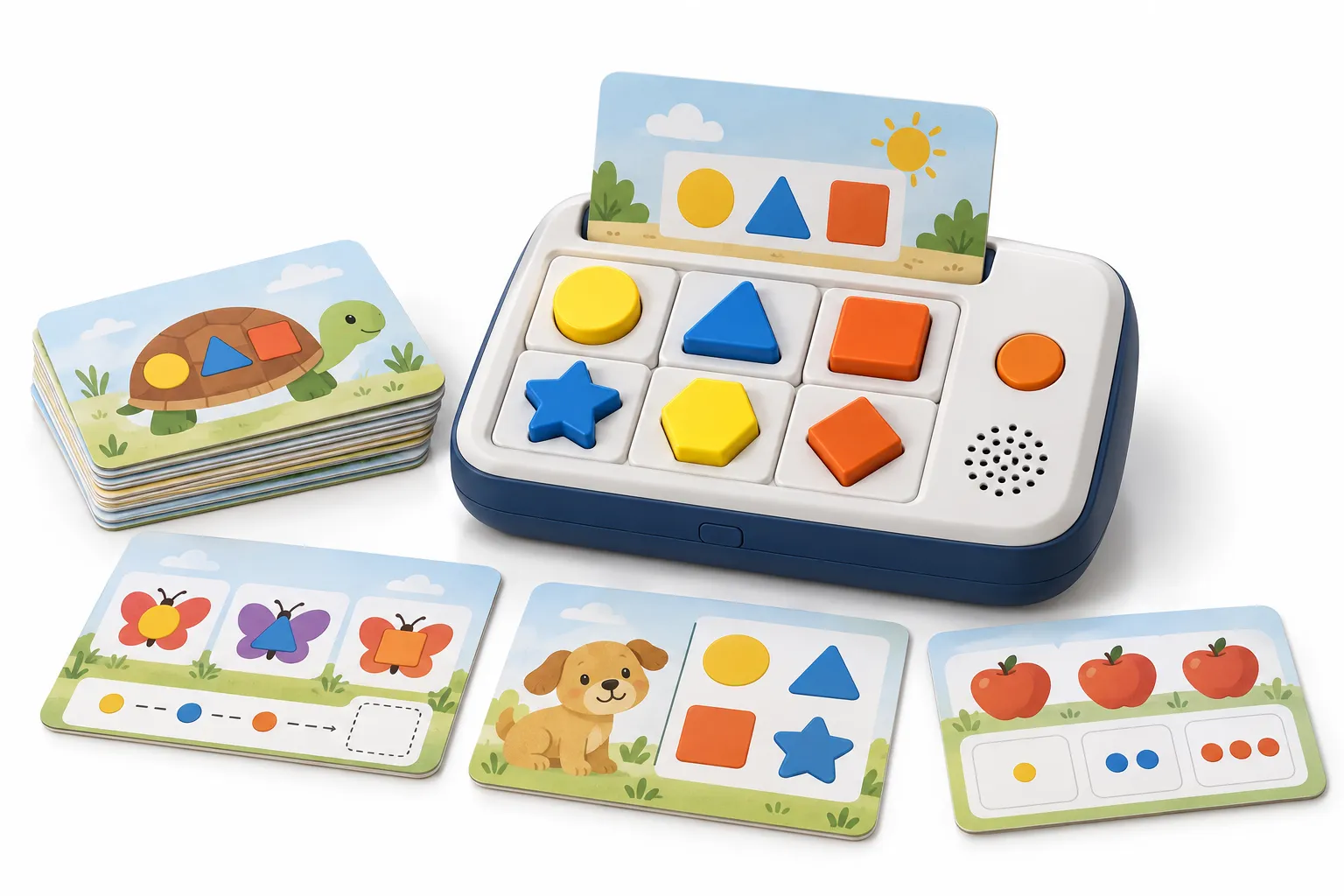
Define the challenge, child action, answer detection and feedback before freezing hardware.
Organize cards by topic, skill and difficulty with controlled answer mapping.
Test correct, incorrect, repeat, timeout and recovery states on physical samples.
Inspect the device, pieces, cards, storage, instructions and packaging together.
The device only creates value when each activity is unambiguous, answer detection is repeatable and the content library can be produced without mapping errors.
Curriculum brands, education companies, publishers and retailers with structured activity concepts.
Prototype representative easy, medium and difficult activities before expanding the full card library.
Sensor layout, tooling, answer pieces, firmware states, card quantity, audio, storage and packaging.
A production-intent device tested with final-size cards, pieces and representative content.
The activity specification becomes the source for mechanical layout, sensor logic, firmware behavior, test media and production inspection.
Review your requirements
Challenge, user action, answer confirmation and useful feedback.
Task-card position, buttons, pieces, storage and child handling.
Sensor zones, tolerances, valid answers and error-proofing.
Question ID, answer map, difficulty, language and artwork revision.
Reference activities that challenge each sensor, feedback state and complete package.
A stable device can support new activity packs when the mapping, identifiers, artwork and compatibility rules are planned early.
Connect pictures, shapes, colors, words or categories with clear answer choices.
Build progressive tasks around order, prediction and visual reasoning.
Support quantities, comparisons, simple operations and number relationships.
Localize instructions, encouragement and card artwork while preserving task logic.
Hardware-only prices omit the work required to map, proof, collate and verify a sellable logic-learning system.
Request a scope review| Decision | What we confirm | Why it changes the quotation |
|---|---|---|
| Activity architecture | Topics, difficulty, answer method and feedback states | Determines sensor, firmware and content work. |
| Device construction | Housing, controls, pieces, storage, power and audio | Determines tooling, components and validation. |
| Content library | Card count, artwork, mapping, languages and versions | Determines design, print, collation and proofing. |
| Test method | Reference cards, boundary cases and acceptance evidence | Determines factory fixtures and functional inspection. |
| Retail set | Accessories, instructions, storage and packaging | Determines final unit cost and pack-out controls. |
Each stage has a tangible output so product, content and commercial decisions stay connected.
Confirm the user, interaction, product configuration, content ownership, target market and commercial assumptions.
Build a representative product with controlled hardware, programmed behavior, content and packaging references.
Close sample issues and verify factory tests, work instructions, pack-out and released files before volume production.
Control the approved configuration through assembly, functional inspection, packing and shipment review.
Product and production evidence
Product, content and commercial requirements are reviewed against the same project brief.
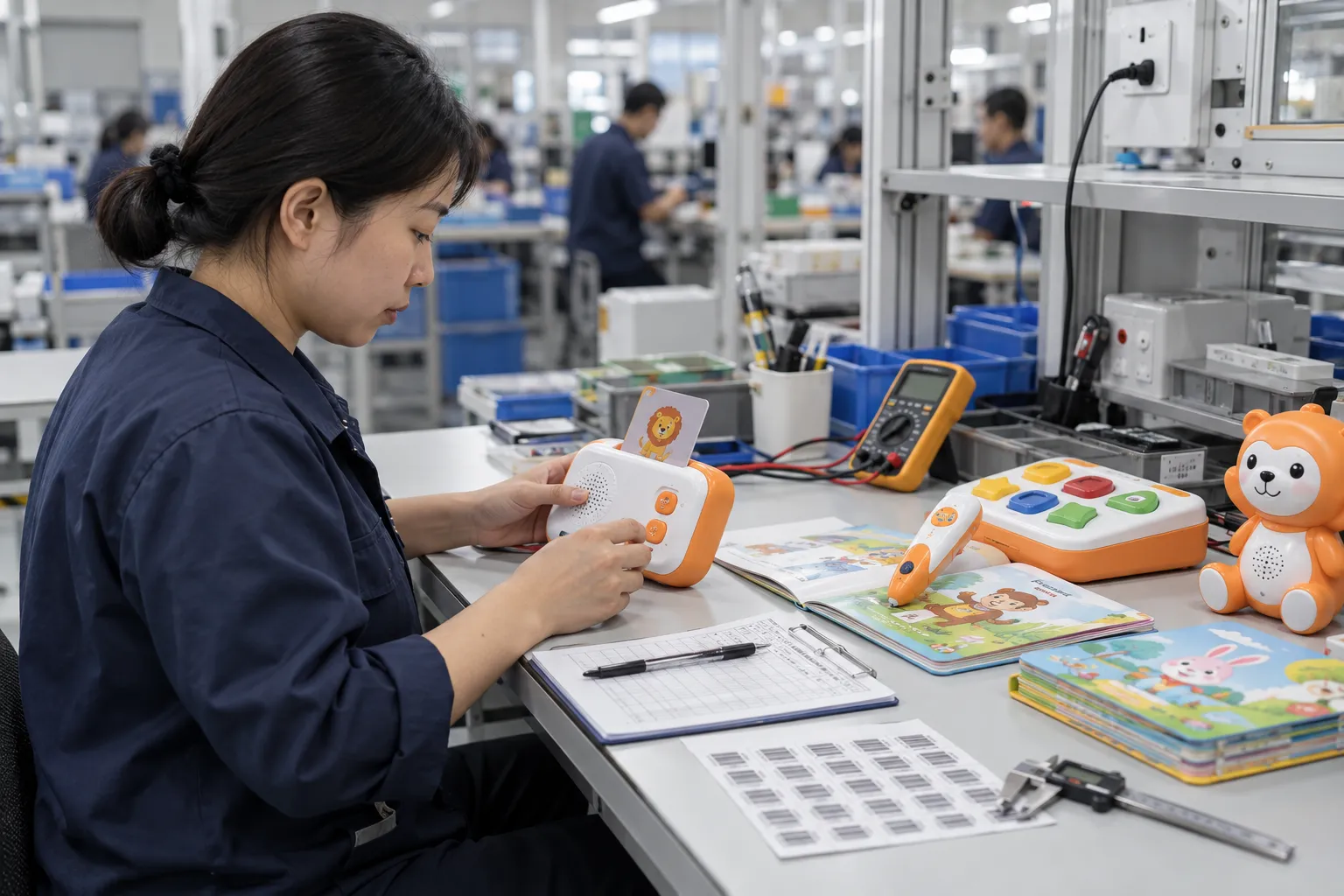
Factory testing links the approved sample with repeatable production checkpoints.
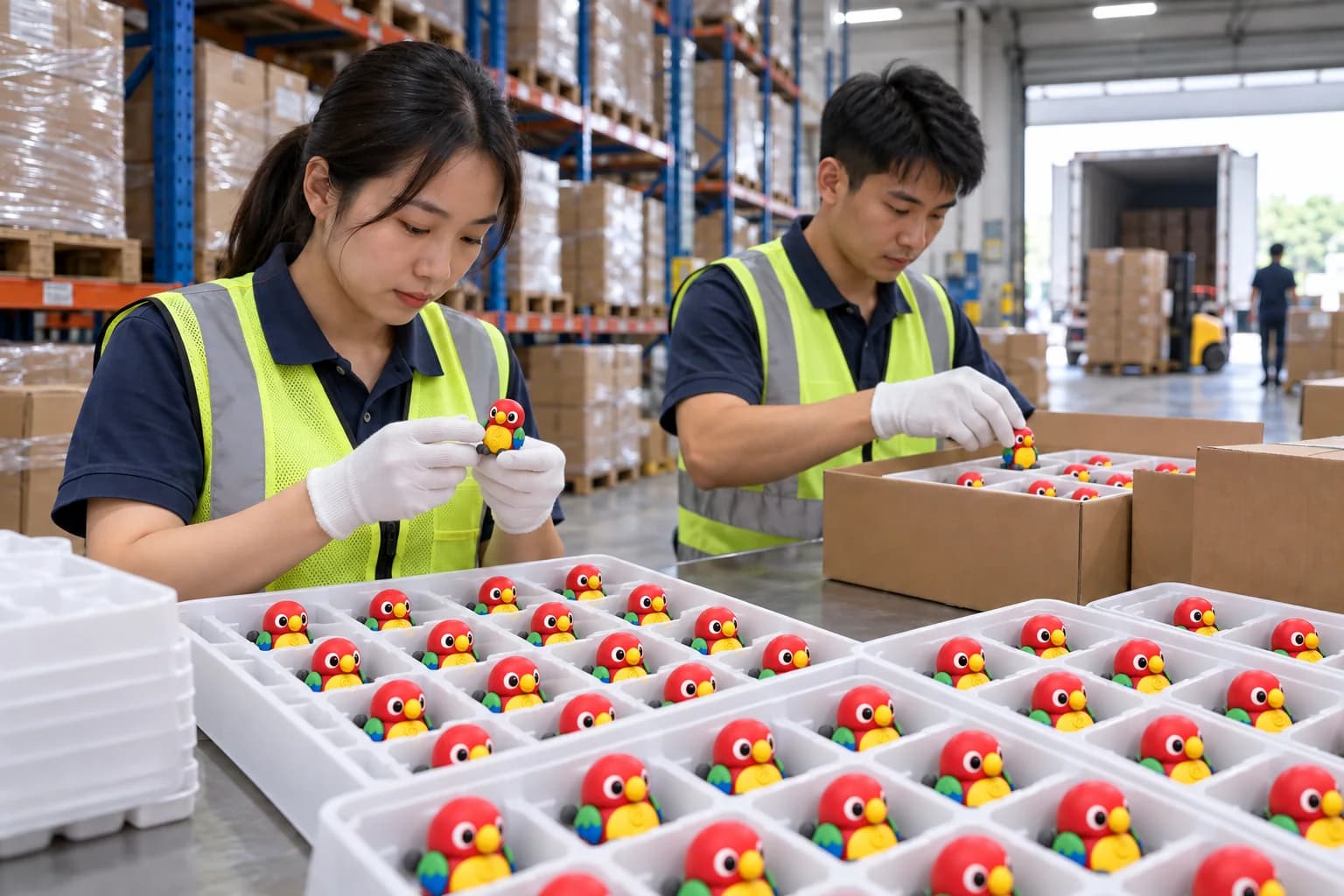
Finished products, accessories, labels and cartons are checked before release.
A working example reveals more than a long feature list and gives engineering, content and commercial teams the same reference.
Practical answers for an initial project review. Final commercial and technical terms belong in the written quotation and approved specification.
It is an interactive educational product that presents a structured task, accepts a physical answer and gives audio, light or other feedback according to controlled activity logic.
Yes. The supplied activities should be converted into a versioned map covering question identity, valid answer, feedback, artwork and difficulty.
Expansion is possible when identifiers, firmware capacity, compatibility and content-release rules are planned before the first product is launched.
Representative valid, invalid and boundary cases should be tested across sensor positions, cards or pieces, normal handling and production tolerances.
Approve the production-intent device, firmware, representative cards, answer pieces, audio, instructions, storage and packaging as one complete set.
Send representative activities and the intended answer method for a focused hardware, content and production review.