
How to Develop a Logic Learning Machine: An OEM Buyer’s Guide
A practical framework for education brands designing card-, tile- or button-based logic activities with clear feedback, controlled content and repeatable production quality.
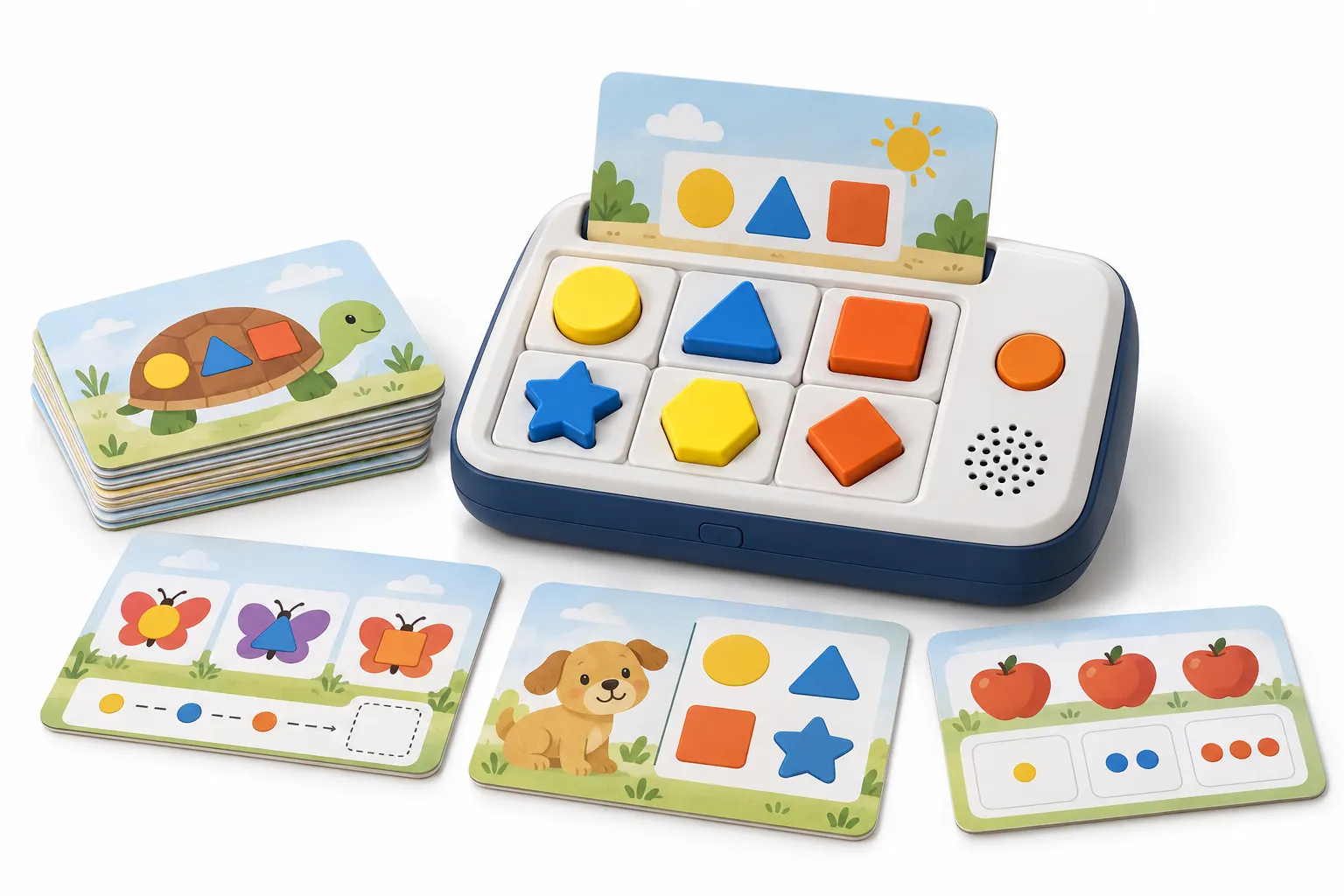
A logic learning machine is not defined by a screen, a speaker or a set of colorful pieces. Its value comes from the sequence a child can understand: receive a challenge, manipulate a card, tile, button or object, submit an answer and receive useful feedback. If that activity loop is unclear, adding more electronics rarely improves the product.
For an OEM buyer, the development challenge is to make the educational concept manufacturable. Content authors may think in puzzles and learning levels, industrial designers in shapes and controls, and engineers in sensors and firmware states. The final product must connect all three. It also has to survive normal handling, reproduce the same feedback across a production lot and arrive with the correct activity set, language and package configuration.
This guide explains how to prepare customer requirements, compare product architectures, validate a prototype and control production without making unprovable claims about learning outcomes. It is written for toy brands, publishers, educational distributors and curriculum companies planning a custom or modified logic learning product.
What is a logic learning machine?
A logic learning machine is an interactive educational toy that presents a structured challenge, accepts a physical input and gives immediate audio, light or mechanical feedback. A reliable OEM design connects age-appropriate activities with unambiguous controls, stable firmware, child-safe construction and testable production specifications.
The category can include a base unit that reads activity cards, a console that detects placed tiles, a question board with answer buttons, or a character-shaped device that guides sequential puzzles. Some designs use electronic answer detection; others combine a simple electronic feedback module with mostly printed or mechanical activities. The correct architecture depends on what the learner must do, not on the number of advertised features.
Buyers should define what the machine can verify. A single-answer vocabulary question is technically different from a spatial puzzle with several valid arrangements. If the device cannot reliably sense the learner's action, the product may need a simpler answer method, such as numbered buttons or coded response cards. Honest limits during concept development prevent expensive firmware or tooling changes later.
Explain one complete activity without mentioning the electronics: what does the learner see, what action is taken, how is the answer submitted and what feedback follows? If that flow is clear, the engineering team can evaluate how to implement it.
1. Define the learning activity loop before selecting hardware
Start with observable behavior. For each activity type, write the prompt, materials, expected action, correct response, incorrect response and reset condition. A sequencing task might ask the learner to arrange three picture tiles and press a confirm key. A pattern task might show a missing element on a card and ask the learner to place the matching piece in a detection area. These flows allow an OEM team to identify sensors, controls and firmware states.
Target age affects more than graphic style. It influences piece size, reading dependence, instruction length, fine-motor demands, number of choices and whether an adult is expected to help. Age grading also affects the safety review. Avoid assigning a younger age simply to broaden the market; use the intended play pattern, skills and product construction as inputs to a documented age-grade decision.
Product application matters as well. A home-use set may prioritize compact storage and independent replay. A classroom product may need volume control, group instructions, replaceable activity packs and easy inventory checks. A retail travel product may require fewer loose components. Defining the environment helps the supplier propose a relevant platform instead of a generic electronic shell.
| Activity question | Example decision | Engineering implication |
|---|---|---|
| How is the prompt delivered? | Printed card plus spoken instruction | Card identification and audio mapping |
| What does the learner manipulate? | Four large coded tiles | Piece geometry, sensing and storage |
| How is an answer submitted? | Automatic detection after placement | Stable read zone and debounce logic |
| What feedback is useful? | Neutral retry prompt, then positive confirmation | Audio states and repeat rules |
| How does the next task begin? | Insert a new challenge card | Reset behavior and card-change detection |
2. Build a content system that can scale beyond the first sample
A scalable logic-toy content system uses defined activity templates, controlled identifiers, difficulty rules and a content map linking every prompt and answer to artwork and audio. This allows new packs or languages to be added without rewriting the entire firmware or losing revision control.
Content should be structured before it is recorded or printed. Create a master spreadsheet or database with an activity ID, topic, intended age or level, prompt text, answer options, correct response, alternate valid responses, feedback lines, artwork reference and audio file names. The exact format can be simple, but it must be the single source used by authors, designers, translators and engineers.
Difficulty progression should be visible in the content rules. Early activities might use two strongly differentiated choices and one-step instructions. Later activities may introduce more choices, two-part patterns or distractors. Do not rely only on labels such as easy, medium and hard. State what changes between levels so sample reviewers can judge whether the sequence is consistent.
For multilingual projects, separate the logic from the language assets whenever the platform permits. The correct-answer rule may remain the same while prompts, feedback and printed text change. Use a terminology list, approved pronunciation notes and an audio status field. Installation preparation should define which final language package and firmware version belong to each SKU before files are loaded onto production units.
Prevent content defects with a three-way review
Review each activity from three perspectives: educational clarity, functional mapping and production files. A puzzle can be pedagogically reasonable but mapped to the wrong sensor code; a correct mapping can still be paired with outdated printed artwork. The approval record should connect all three.
Plan expansion without promising unlimited content
Ask how many identifiers, audio assets and activity types the chosen platform can support and how future packs will be distinguished. Confirm memory and firmware constraints using the real asset plan. A practical reserve is useful; an undefined promise of unlimited expansion is not.
3. Choose a reliable interaction and feedback architecture
The sensing method should match the physical action. Buttons are easy to understand and test but may limit the number of answer choices. Conductive contacts can detect pieces in defined positions but require control of contact pressure and contamination. Optical or coded recognition can support larger content libraries but depends on readable marks, alignment and controlled printed components. Magnets can support positioning, while separate sensors determine whether the device can identify individual pieces.
A prototype should test misuse as well as the intended action. What happens when two buttons are pressed, a tile is placed halfway, the learner changes a card during playback or the unit is switched off before an activity completes? Firmware should return to a predictable state. Feedback should be clear without shaming the learner: a neutral retry response, a helpful cue or a repeat instruction is often more useful than a harsh error sound.
Audio and light feedback require restraint. Speech must remain intelligible through the final enclosure and at the configured volume. Light indicators should support the activity, not compete with it. If a vibration or mechanical movement is proposed, confirm that it contributes to the product application and does not create unnecessary power, noise or reliability risk.
- Make the correct operating action visually obvious
- Keep feedback consistent across activity types
- Define behavior for incomplete or conflicting inputs
- Provide a simple repeat or instruction function where appropriate
- Record every state in a firmware behavior table
- Test the interaction with representative users under responsible supervision
4. Design the housing, pieces and storage as one product
Industrial design should start from hand access, visibility and component control. The learner must be able to place pieces without blocking important information or accidentally activating another control. Buttons need sufficient spacing and tactile distinction. Card slots should guide insertion without requiring excessive force. Loose elements need a storage solution that is realistic for the intended package and use environment.
Ask the supplier to identify every child-accessible part, fastener, opening, edge and moving feature. Small decorative elements, detachable feet or poorly retained battery doors can create avoidable risk. Materials, surface finishes and printed graphics should be selected with the final age grade and destination market in mind, then held under an approved bill of materials rather than substituted informally during purchasing.
Serviceability needs a deliberate position. Replaceable batteries may require a secured compartment and clear instructions. Rechargeable designs add charging components, indicators and cable decisions. Activity cards and tiles may be replaceable, but the device itself may not be intended for consumer repair. State the intended service model so the enclosure and documentation are consistent.
| Physical area | Buyer review | Production control |
|---|---|---|
| Controls | Reach, spacing, labels and tactile response | Golden sample and functional fixture |
| Cards or tiles | Orientation, readability, durability and count | Dieline, print proof and pack-out checklist |
| Housing | Grip, stability, openings, edges and assembly | Approved drawings, materials and appearance limit |
| Power access | Adult access, fasteners and instructions | Torque or closure check as applicable |
| Storage | Can users keep the set complete? | Tray, bag or compartment specification |
5. Specify electronics, audio and firmware with testable criteria
An OEM specification should name the functional configuration rather than depend on a catalogue description. Document the power source, charging method if any, processor or platform reference, memory requirement, speaker configuration, sensors, controls, indicators and external connections. Component details may evolve during engineering, but any safety- or performance-relevant change should require review.
Runtime statements need a test condition: battery type or charge state, playback level, activity cycle, light use and sleep periods. Audio capacity depends on format, bitrate, number of languages and file duration. Work from actual sample assets before freezing memory. The goal is not to maximize every specification, but to choose a balanced configuration that supports the intended experience reliably.
Create a firmware behavior table for startup, volume, prompt, input, retry, correct answer, card change, inactivity, low power and shutdown. Give each release a version identifier and keep a change log. Factory programming should use a controlled master package, and finished units should provide a defined method for confirming that the correct build is installed.
Electric toys should be reviewed for applicable market requirements. IEC 62115 describes safety requirements for toys with at least one function dependent on electricity, while national or regional requirements can differ. The responsible manufacturer or importer should confirm the applicable standards and test scope with a qualified laboratory for the final configuration.
6. Approve the product through staged samples
A staged approval process separates conceptual, mechanical, electronic and content risk. Begin with an interaction mock-up or appearance model to confirm scale, control layout and activity flow. Use an engineering prototype to verify sensing and firmware behavior. Add final-like printed content and audio in a functional sample. Then use tooling samples and a pilot build to evaluate repeatability, assembly and packaging.
Do not expect one prototype to prove everything. A 3D-printed enclosure may confirm ergonomics but not final material strength or surface quality. A hand-wired electronics sample may demonstrate the logic but not production assembly. A digitally printed card may confirm wording while differing from mass-production color, coating or recognition performance. Every sample report should state what was evaluated and what remains open.
Freeze the product with an approved reference set: device, firmware, audio package, content map, cards or pieces, accessories, retail package, labels and instructions. List deviations that are still permitted. If customer requirements change after approval, record the affected documents, cost, timing and need for re-testing before authorizing the change.
7. Connect factory testing to the real activity experience
Factory testing for a logic learning machine should verify the installed configuration, every input type, representative correct and incorrect answers, audio or light feedback, power behavior and pack-out. Controlled fixtures and activity cards should be tied to the current firmware and content revision.
Incoming controls should confirm critical parts and approved materials. First-article inspection should verify assembly, sensor position, controls and the programmed configuration before a production run continues. In-process checks can identify loose connections, incorrect component orientation or mechanical interference before the housing is fully closed.
Functional testing must go beyond power-on. A controlled test sequence should exercise each button or sensing zone, a representative set of activity identifiers, correct and incorrect feedback, speaker output, indicators, volume, inactivity behavior and power functions. Where full content checking on every unit is impractical, combine complete validation of the master software package with defined production sampling and targeted unit-level function checks.
Shipment inspection should compare finished, packed units with the approved sample and specification. Inspectors should verify quantity, workmanship, function, content revision, cards or tiles, instructions, labels, accessories, retail packaging and shipping cartons under an agreed sampling plan. A shipment inspection does not replace compliance testing, but it can reveal whether the delivered lot matches what was approved.
Record defects by category and isolate nonconforming units. Repaired products should repeat the relevant tests before returning to good stock. Trend information from pilot and production builds is more useful than a single pass-rate claim because it shows which problems recur and whether corrective action is effective.
8. Evaluate a logic learning machine manufacturer
A suitable supplier should be able to discuss content, mechanics, electronics and quality in one project language. Ask the team to review one real activity and explain how it would be detected, mapped, programmed and tested. This exposes gaps more quickly than asking whether the factory has made educational toys before.
Compare quotations against the same brief. Separate development fees, molds, electronics, printed content, audio work, packaging, compliance support and recurring unit cost. Minimum order quantity may be driven by custom plastic, PCB purchasing, printing or package setup; ask which item creates the constraint and whether a validated platform can support a lower-risk launch.
Review project management evidence: named owners, revision-controlled documents, written sample reports, change approval and a production quality plan. Do not treat a generic certificate or a photograph of equipment as proof that the proposed model is covered. Relevant reports must match the materials, age grade, functions and construction of the actual product.
The best partner is not necessarily the factory promising every feature immediately. It is the one that identifies unknowns, tests them early and keeps the approved product definition stable through manufacturing and shipment.
Frequently asked questions
What should I send a logic learning machine manufacturer for a quotation?
Send the target age, product application, one or more example activities, interaction method, languages, quantity, destination market, preferred power source, reference dimensions and packaging expectations. Mark what is fixed and what the supplier may propose.
Can a logic learning toy use new activity packs later?
It can if the platform, identifier system, memory, firmware and commercial ownership are planned for expansion. Confirm how new packs will be recognized, how audio will be installed and whether earlier products remain compatible.
Which feedback method is best for a children's logic machine?
There is no universal best method. Spoken prompts are informative, lights are quick, and mechanical feedback can be engaging. Select the simplest combination that clearly supports the activity and can be tested reliably.
How long does custom development take?
Timing depends on whether the project uses an existing platform, modified electronics or new tooling, plus the readiness of content and compliance requirements. Ask for a milestone schedule covering design, engineering samples, tooling, validation, pilot production and shipment rather than one unsupported delivery date.
What quality tests should be performed during production?
At minimum, verify product identity, firmware and content version, every input type, representative answer logic, feedback, audio, indicators, power behavior, assembly, cards or pieces, labels, accessories and packaging. Safety and reliability tests should be defined for the actual design and market.
Does a logic learning machine need toy certification?
Requirements depend on intended age, functions, materials, power system and destination market. In the United States, applicable children's toy requirements and certification should be reviewed with the responsible party and a CPSC-accepted laboratory. Other markets use their own legal routes and standards.
Conclusion
A successful logic learning machine is a controlled system, not a collection of features. The activity rules define the interaction; the interaction defines the mechanics and electronics; and the approved configuration defines factory testing and shipment inspection.
Begin with a small set of representative activities, document every state and validate risk in stages. That approach gives an education brand or distributor a clearer quotation, a more useful sample and a stronger basis for scaling content after launch.
Authoritative references
Requirements change and differ by product. Use the current official source and qualified professional advice for the final project.