
How to Localize an Electronic Learning Toy for Multiple Languages
A practical guide for brands coordinating translation, native-speaker review, voice recording, artwork, firmware, market labels and multilingual production SKUs.
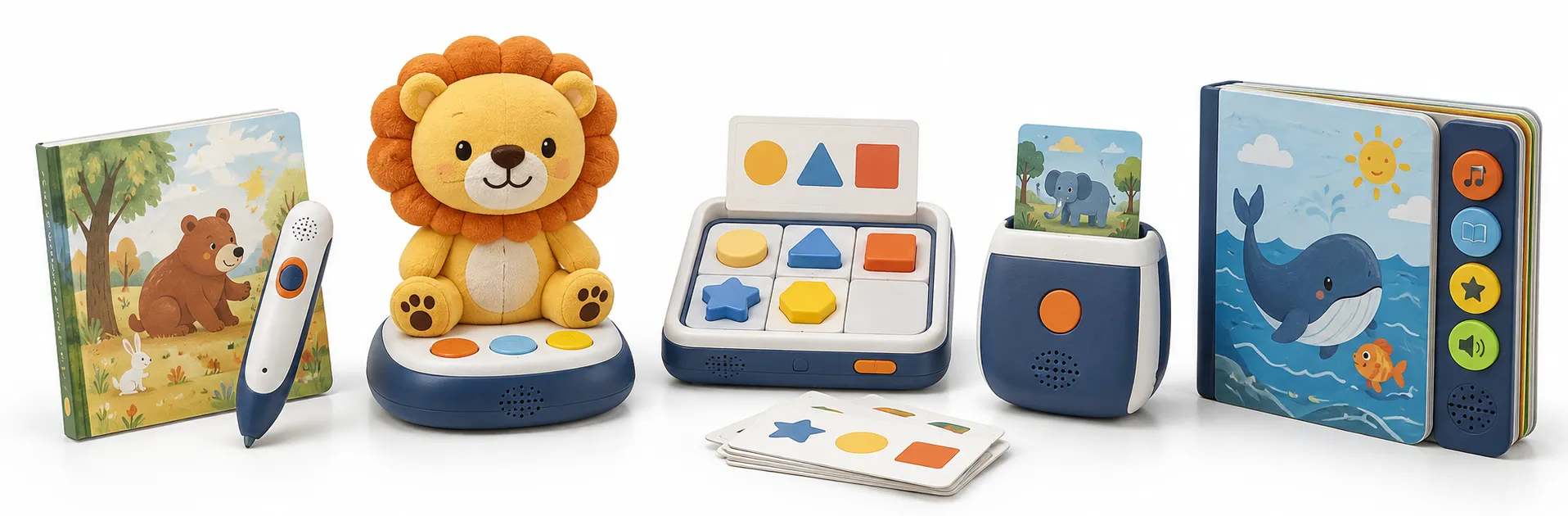
Localizing an electronic learning toy means adapting the complete user experience for a defined language and market. Translation is one part. The finished edition may also require new recordings, altered illustrations, text expansion, right-to-left layout, different pronunciation guidance, market labels, instructions, firmware settings, packaging and a distinct production SKU.
A product can sound fluent while remaining operationally wrong. The audio may be loaded onto the wrong color version, a language button may display an outdated abbreviation, cards may be packed with another locale, or the retail box may omit required operator information. These are configuration-control problems as much as language problems.
This guide gives toy brands, publishers and importers a structured process for talking pens, flash card machines, sound books, talking figures and logic learning devices. It avoids the assumption that one translation file can be copied across every asset and instead connects language decisions with product engineering, factory testing and shipment inspection.
What does multilingual educational toy localization include?
Multilingual toy localization includes locale planning, translation, cultural review, voice recording, terminology control, artwork and layout adaptation, firmware and audio integration, packaging and label updates, linguistic-functional testing, and factory controls that install and pack the correct language edition.
A language is not always a single market. English may require different vocabulary, spelling, voices or packaging for the United States and United Kingdom. Spanish varies by target region. French for France and French for Canada can have different terminology and market information. Define a locale as the combination of language and intended regional use rather than using only a country flag.
The amount of localization depends on the product. A sound book with ten fixed songs may need print, recording and button mapping. A talking pen library may contain thousands of touchpoints and several operating modes. A talking character may depend on personality, humor and timing. Scope should be based on real assets and behavior.
Treat every language edition as a controlled product configuration. It can share hardware with other editions, but its text, audio, artwork, firmware, labels and pack-out must have an identifiable approved release.
1. Define target locales, markets and SKU architecture
Build a locale matrix before translation begins. List source and target locale, destination countries, planned sales channel, product model, content volume, voice count, packaging languages, manual languages, market labels, barcode or SKU and responsible reviewer. This shows which versions can share assets and which require separate releases.
Decide whether one physical product contains several selectable languages or whether each market receives a single-language SKU. A multi-language device may reduce hardware variants but increase memory, user-interface and pack-out complexity. Single-language editions simplify the consumer experience but require stronger warehouse and carton identification.
Define fallback behavior. If a user changes language during an activity, does the device restart, continue with equivalent content or block the switch until completion? If a card or book is unsupported in the selected language, what response occurs? These are product and firmware decisions that translators alone cannot resolve.
Review market scope with qualified compliance professionals. Required warnings, instructions, responsible-business information and product documentation depend on destination, product type and commercial role. Do not assume that translated marketing copy satisfies mandatory language or labeling obligations.
| Locale matrix field | Example decision | Production effect |
|---|---|---|
| Locale | es-MX rather than generic Spanish | Selects terminology, voice and artwork |
| Product model | One bilingual reader or two SKUs | Changes memory, controls and pack-out |
| Content coverage | Full library or selected titles | Defines recording, mapping and testing volume |
| Packaging | Local language plus importer details | Creates market-specific artwork release |
| Reviewer | Named native language and market reviewer | Provides accountable approval |
2. Prepare localization-ready source content
Localization-ready source content uses stable IDs, clear context, approved terminology, separated text and audio assets, defined placeholders or limits, and version control. Translators should receive the meaning, user action, speaker and visual reference—not isolated words copied from artwork.
Create a content inventory covering device prompts, lessons, card text, book text, audio scripts, button labels, packaging, manual, warnings and digital support materials. Assign stable IDs that persist across languages. Link each item to a screenshot, page, card or interaction where context affects translation.
Remove ambiguity from the source. The English word 'press' could be a verb, a printing process or a media organization. A translator who sees only the word may choose the wrong meaning. Include product action, audience, character, tone and any length or timing constraint.
Build a glossary for product names, recurring instructions, educational terms, character names, buttons and feedback. Mark terms that must remain in the original language or follow a licensor's approved spelling. A style guide should address tone, formality, punctuation, numbers, capitalization and the treatment of gender or plural forms where relevant.
Freeze the source for each localization release. Late editorial changes can be handled, but they need a change record and impact check across translations, recordings, artwork, mapping and test scripts. Sending an updated spreadsheet without identifying changed rows invites missed revisions.
3. Translate meaning, then adapt it to the learner and market
Use translators who understand the target locale, intended age and content type. A children's instruction needs clarity and natural phrasing, while a package warning may require formal, legally reviewed language. One person may not be qualified to approve every asset. Define editorial, educational and regulatory review responsibilities separately.
Translation and localization are not identical. Localization can adapt examples, units, date formats, alphabets, names, rhymes, wordplay and cultural references. A picture used to teach a word must still match the translated concept. If the illustration cannot be interpreted correctly in the target language, change the image or select a different example instead of forcing a literal translation.
For alphabet, phonics and pronunciation products, content may require redesign rather than translation. Letter-sound relationships and example words differ by language. A curriculum owner or qualified language education specialist should define the learning sequence; the factory should implement the approved content without making unsupported pedagogical decisions.
Use two levels of review when risk justifies it: an independent linguistic review of the translated text and an in-context review inside the artwork or functional product. Resolve comments in the content database so approved changes flow to audio, print and firmware rather than being corrected only in a PDF.
Back translation can help stakeholders inspect high-risk or unfamiliar languages, but it is not proof of quality by itself. It may introduce a second interpretation. The final approval should come from qualified target-language reviewers using the actual content and context.
| Content type | Localization question | Recommended reviewer |
|---|---|---|
| Learning prompt | Is it clear and age-appropriate? | Native language educational editor |
| Character dialogue | Does personality sound natural? | Native creative editor or voice director |
| Phonics activity | Does the learning logic work in this language? | Qualified language-learning specialist |
| Packaging claim | Is the meaning accurate and supportable? | Brand and market reviewer |
| Warning or instruction | Does it meet applicable market needs? | Qualified compliance or legal reviewer |
4. Produce multilingual voice audio with consistent direction
Prepare a recording script by locale, voice and content ID. Include source text for reference, approved translation, context, pronunciation, emotional direction, character, expected pace and whether timing must align with a light, page or activity. Do not send a studio unlabeled columns of isolated phrases.
Select native or appropriately fluent voice talent for the intended locale and audience. Approve auditions using representative material, including instructions, vocabulary, questions, feedback, narration and emotionally distinct lines. If multiple titles share a character, document voice continuity and commercial usage rights.
A language director or reviewer should attend or review early recording samples. Correcting pronunciation and intent during the session is more efficient than rerecording after thousands of files are edited. Track pickups by content ID and never replace an approved master without updating status.
Editing should preserve archival masters and create device-ready derivatives. Normalize perceived level carefully across speakers while retaining intelligibility. File duration varies by language; long translations may require a faster but still natural performance, script adaptation or firmware timing changes. Do not simply speed up approved speech to fit an arbitrary limit.
Listen on the target product. Small speakers can obscure consonants or make high-energy voices harsh. Review quiet words, numbers, similar phonemes, music and effects at permitted volume settings. The technical approval should identify the device, enclosure, firmware and audio release used.
- Voice talent and recording rights cover the intended products, markets and duration
- Pronunciation notes reflect the target locale rather than a generic language label
- Every take and pickup retains its stable content ID
- Masters and device-ready files are stored separately
- Native reviewers approve meaning and pronunciation
- Device listening confirms clarity, level and timing
5. Adapt artwork, interfaces, cards and packaging
Text expands and contracts across languages. Reserve flexible areas and test the longest expected strings. Do not reduce important instructions to unreadable type simply to preserve an English layout. Reflow copy, enlarge a panel or revise the wording while keeping the approved meaning.
Writing systems require appropriate fonts and rendering. Confirm character coverage, diacritics, shaping and punctuation. Right-to-left languages can affect reading order, page layout, icons, progress sequences and the relationship between text and images. W3C internationalization guidance emphasizes identifying language and text direction in data; the same principle is useful in a content database so files are processed correctly.
Review illustrations and symbols in the target market. Hand gestures, maps, food, clothing, school objects and colors can carry different meanings. Adapt when the difference would confuse or misrepresent the lesson. Avoid unnecessary changes based on stereotypes; use informed reviewers and documented reasons.
For physical controls, decide whether labels are translated, replaced with language-neutral symbols or supported by instructions. A multi-language product may use a globe icon plus spoken confirmation. Any symbol should be tested with users and reviewed against applicable standards or market expectations rather than assumed to be universal.
Packaging and manuals need configuration control. Link the correct retail box, barcode, importer information, warnings, instructions and promotional claims to each SKU. The factory should receive released artwork and an approved visual pack-out reference for every locale.
6. Control firmware, memory and language-specific SKUs
Multilingual toy firmware should use stable locale identifiers, defined language-switching behavior, versioned audio packages and enough memory for approved assets. Production needs a release matrix showing which hardware, firmware, content, artwork and packaging belong to each language SKU.
Do not identify production language only by folder name. Assign a unique SKU and locale code that appears in the release matrix, programming package and inspection document. Follow established language-tagging conventions where useful, but keep the production identifier understandable to factory and warehouse teams.
Memory planning should use device-ready files from representative languages. Some translations and recordings are longer than the source. Include file-system overhead and controlled reserve for corrections or planned additions. If a lower-memory configuration is used for one SKU, it becomes a distinct component and change-control decision.
Define the language-selection experience. A physical switch is visible but occupies space. A button sequence can be harder to discover. Automatic book or card identification may be convenient but requires reliable mapping. Spoken confirmation should use the selected language and remain available after a reset if that is the approved behavior.
Installation preparation combines firmware, audio, content maps and SKU. Generate one released package per configuration, restrict programming stations to current versions and define a verification method. This may be a diagnostic audio, screen, code, label or tool output depending on the platform.
Changes require regression testing. Updating one translation can affect file order, package size, mapping or timing even if other languages did not change. The release note should identify changed IDs and the test team should confirm both the correction and unaffected critical functions.
| Release control | Required record | Failure prevented |
|---|---|---|
| Locale ID | Language-region and SKU code | Generic or wrong regional version |
| Content package | Version, size and file count | Missing or mixed audio |
| Firmware | Version and supported hardware | Incorrect language-switching behavior |
| Artwork | Cards, books, labels and box revision | Audio and print mismatch |
| Programming check | Diagnostic or installation result | Wrong build packed into a finished SKU |
7. Run linguistic, visual and functional localization QA
Linguistic QA checks meaning, grammar, spelling, punctuation, terminology, tone and consistency. It should review content in context, not only a spreadsheet. The reviewer needs to see the page, card, control or interaction and hear the audio through the actual or representative device.
Visual QA checks truncation, overlapping text, font substitution, missing glyphs, line breaks, reading order, mirrored elements and alignment. Inspect printed proofs because screen rendering does not reproduce every font, color, finish or cut effect. For right-to-left layouts, verify navigation and icon direction deliberately rather than mirroring the entire design automatically.
Functional QA checks mapping and states. Every selected button, card, touchpoint or activity should trigger the correct target-language response. Test language switching, repeat, volume, incorrect answers, interruptions, low power, resets and unsupported content. Confirm that voice prompts match visible labels and manuals.
Use defect categories and stable IDs. A mistranslation, wrong file, missing glyph, print overflow and firmware-state error need different owners. Record expected result, actual result, device and content version, asset reference and retest status. Screenshots and audio clips can help reproduce issues.
Final market review should include packaging, labels and instructions. A toy can pass in-device linguistic QA yet ship with the wrong barcode or responsible-business details. Compliance approval must be handled by appropriately qualified parties for each destination market.
8. Install, pack and inspect multilingual production versions
The production release matrix should connect hardware, housing color if relevant, firmware, audio package, printed components, accessories, manual, retail package, barcode and carton mark. Work orders and stations should display the exact SKU. Similar-looking language editions should be physically separated or otherwise controlled during programming and pack-out.
Factory testing should confirm installed locale and core functionality on every programmed unit using a defined method. Controlled books, cards or buttons can verify representative mapping. Printed component inspection should confirm language, revision, code or identifier and completeness. Pack-out should use a locale-specific visual reference.
Line clearance matters when changing languages. Remove previous audio masters, labels, cards, manuals and boxes from the station before releasing the next SKU. Record the transition and first article. A correct product in the wrong retail package is still a failed configuration.
Shipment inspection should select finished cartons across the lot. Verify SKU, language, function, content version, printed materials, barcode, labels, accessories and carton marks. Native-language sampling may be needed to judge audio and text; inspectors without the language can still verify IDs and mapping but should not claim linguistic approval.
After shipment, maintain traceability by batch and configuration. If a language error is reported, the team should identify which release and lots are affected. Corrective action may require new files, reprogramming, replacement print or package changes; document the scope rather than treating it as an isolated audio complaint.
In multilingual manufacturing, the final quality question is not only 'Does it work?' It is 'Is this the correct approved language configuration in the correct market package?'
Frequently asked questions
What is the difference between translation and toy localization?
Translation changes text from one language to another. Localization adapts the complete product for a defined locale, including terminology, voice, examples, artwork, layout, firmware behavior, packaging, instructions and market-specific information.
Should one toy include several languages or use separate SKUs?
A multi-language model can share hardware and allow consumer selection, but it needs more memory and clear switching behavior. Separate SKUs can simplify use while increasing programming, inventory and pack-out control. Choose based on content volume, channel and market plan.
Who should review children's educational translations?
Use qualified native-language reviewers who understand the target age and market. Learning activities may also need an educational specialist, while warnings and mandatory information require appropriate compliance or legal review.
How should multilingual voice files be named?
Use stable content IDs linked to locale, voice and status in a controlled database. The final device filename may follow platform rules, but the mapping must preserve traceability to the approved script and recording.
How is a multilingual learning toy tested in production?
Verify the installed locale and release, representative audio mapping, language switching, controls, printed content, labels, manuals, packaging, barcode and carton marks against the SKU release matrix.
Can the same test report cover every language version?
Language changes may not alter every physical safety test, but new artwork, labels, audio, firmware or components still require configuration and compliance review. The responsible party and laboratory should determine what evidence remains applicable.
Conclusion
Multilingual educational toy localization succeeds when language and manufacturing use the same controlled data. Stable IDs, qualified reviews, device-tested audio, locale-aware artwork and a clear SKU matrix connect creative adaptation with factory execution.
Plan locales before recording, review content in context and treat each market edition as an approved configuration. This reduces translation rework, mixed-language shipments and the risk that correct individual assets are assembled into the wrong finished product.
Authoritative references
Requirements change and differ by product. Use the current official source and qualified professional advice for the final project.