
Talking Pen vs Flash Card Machine vs Sound Book: Which Product Fits Your Content?
A practical comparison for education brands and publishers choosing the right screen-light audio learning platform for a new product line.
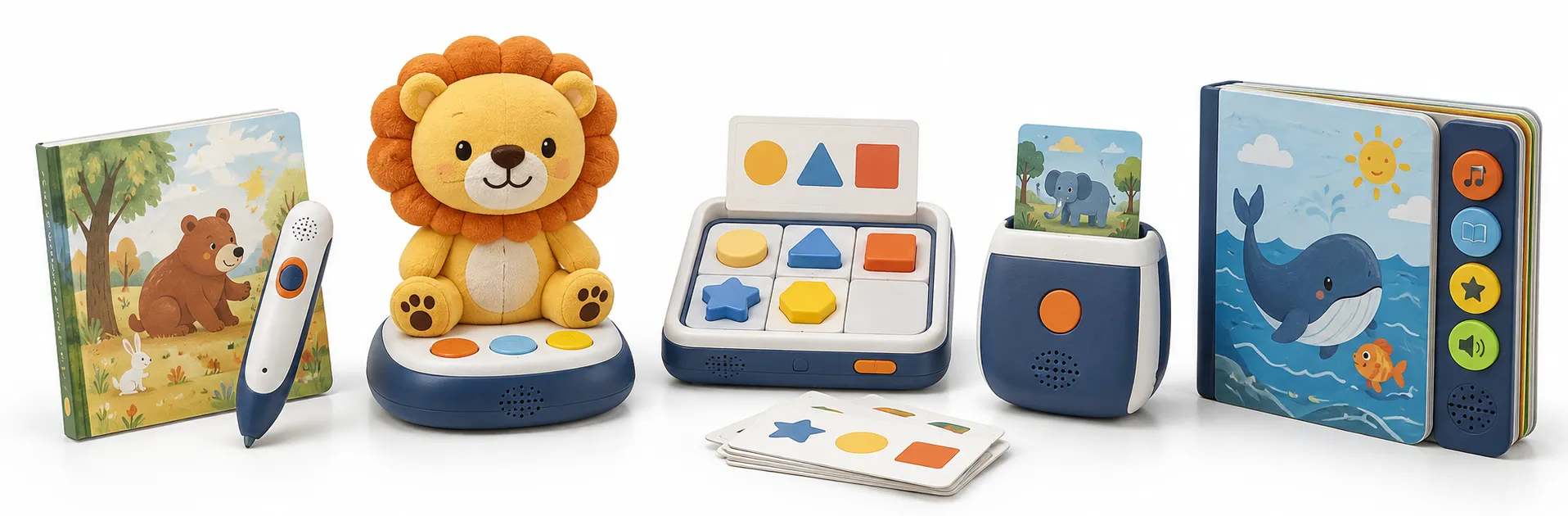
A talking pen, flash card machine and sound book can all deliver audio learning without making a screen the center of the experience. They are not interchangeable, however. Each format asks the child to do something different, requires a different content-production workflow and creates a different retail package.
For an overseas buyer, the wrong decision often appears late. A team may choose a flash card reader because the hardware looks simple, then discover that its curriculum requires page-level activities. A publisher may choose a talking pen without allowing enough time for code mapping and print proofing. A sound book may fit the story perfectly but offer less flexibility for a growing library of titles.
This guide compares the platforms from a product-development perspective. It focuses on product application, learner interaction, content preparation, customization, factory testing and shipment inspection so buyers can choose a realistic starting point.
Which product platform should you choose?
Choose a talking pen for expandable, touch-sensitive books and learning systems; a flash card machine for compact vocabulary repetition with simple insert-and-play use; and a sound book for an integrated publication where buttons, audio and pages ship as one product. Content structure and learner interaction should lead the decision.
A buyer should not begin with the question, “Which product is cheapest?” Start with what the child needs to do. If the experience depends on touching many points across several pages, a talking pen is usually the strongest candidate. If the goal is quick recognition of one image or word at a time, a flash card machine is efficient. If the content is a fixed story, song or first-word book, an integrated sound book can be more intuitive.
Commercial constraints still matter. Printed card count, book construction, audio duration, packaging size, memory, tooling and compliance preparation all influence the final program. The purpose of the comparison is to identify the best functional fit before those costs are optimized.
1. How do the three audio learning formats work?
Talking reading pen
A talking pen uses an optical reader to identify coded positions on a printed page, card, poster or worksheet. The pen maps each recognized code to an audio file or programmed action. A single page can support full narration, individual vocabulary, music, questions and answer feedback.
The platform is well suited to publishers because the electronic device can support a growing printed content library. The trade-off is a more involved content workflow: artwork coding, audio mapping, firmware behavior and physical print recognition all require coordinated approval.
Flash card learning machine
A flash card machine identifies a card when the child inserts it into the reader. The device then plays a word, phrase, environmental sound or short prompt. The interaction is deliberately narrow, which makes it easy to demonstrate, repeat and use independently.
This format works well for first words, phonics, bilingual vocabulary and themed picture-card libraries. Its content system is simpler than a multi-touch book, but card identification, print consistency, audio mapping and physical card durability still need to be validated together.
Sound book
A sound book integrates a speaker, battery and button panel into the publication. Each button normally corresponds to a page, illustration, sound, song or story segment. The product arrives as one complete object rather than a reusable electronic reader plus separate content items.
Sound books are intuitive for fixed, curated experiences. They can be attractive gift products and require no separate pen or loose card library. Their main constraint is that the electronics and printed book structure are physically connected, so changing or expanding the content generally means producing another book configuration.
2. Talking pen vs flash card machine vs sound book: side-by-side comparison
The table describes the normal design logic, not a fixed technical limit. A talking pen can read cards, a card machine can include quiz modes, and a sound book can use creative panel arrangements. The more a project moves away from a validated platform, the more carefully the supplier should review engineering, usability and testing implications.
Buyers should also consider the complete package. A large talking pen library may need book storage and clear title labeling. A flash card set needs an organized card box that prevents loss and damage. A sound book needs packaging that protects the thicker electronic module and prevents buttons from being held down during transport.
| Decision factor | Talking pen | Flash card machine | Sound book |
|---|---|---|---|
| Primary interaction | Touch coded areas on print | Insert one card | Press integrated buttons |
| Best content | Books, worksheets, posters, activities | Vocabulary and recognition cards | Stories, songs, sounds and first words |
| Content density | High; many touchpoints per page | One main item per card | Limited by page and button layout |
| Library expansion | Strong when code and file planning allow | Strong through additional compatible cards | Usually a new book or module |
| Loose parts | Pen plus printed items | Reader plus card set | Usually one integrated product |
| Content preparation | Artwork coding and detailed mapping | Card identification and audio mapping | Page, button and audio mapping |
| Typical differentiation | Curriculum depth and expandable titles | Portable repetition and themed card sets | Giftable integrated publishing experience |
3. Match the product platform to the content you already have
Existing content is often the strongest clue. A publisher with illustrated storybooks and editable page files can evaluate whether touchpoints, narration and activities add value. A vocabulary brand with hundreds of isolated images may be able to organize them into flash card themes more efficiently. A music publisher with twelve songs and a simple visual concept may create a clearer product with an integrated sound panel.
Do not assume every piece of content should become interactive. Select interactions that help the learner navigate, understand, repeat or respond. Too many touchpoints can make a talking pen book feel noisy. Cards with long explanations can weaken the immediate insert-and-play experience. A sound book with crowded buttons may be harder for young children to use.
Content ownership and readiness also affect the schedule. The buyer should confirm artwork rights, audio rights, translation, voice recording and approval responsibility. Draft content can support early feasibility, but production planning needs controlled files and a clear change process.
Choose ten representative learning items and prototype them in each plausible format. Compare the learner action, audio length, adult explanation required and number of physical components before committing to a full library.
4. Compare learner interaction, age fit and supervision
Age recommendations should follow product design, intended use and professional safety assessment; they should not be selected only for marketing. From a usability perspective, younger learners generally benefit from large targets, limited controls, clear feedback and short audio. Older children can follow more complex prompts, categories and quiz logic.
A talking pen requires the child to aim at a printed target and keep track of a separate device. This can support exploration but may need demonstration. A flash card machine uses a repeatable motor action—select, insert and listen—which can be easy to learn, though loose cards need storage. A sound book keeps the controls attached to the content and can be immediately understandable, especially when each button visually corresponds to one page element.
Consider where the product will be used. In classrooms, a reusable pen with multiple books may support shared content systems, but charging and device management require a plan. For travel, a compact card reader may be convenient if cards are contained securely. For bedtime stories or gifting, an integrated sound book may feel more familiar to families.
- Can the intended learner operate the control accurately and comfortably?
- Does the interaction produce an immediate, understandable response?
- Are loose parts appropriate for the intended age and environment?
- Can volume, repetition and mode changes be managed without confusion?
- Does the product still make sense when an adult is not explaining it?
5. Compare customization depth, tooling and development work
All three platforms can be customized through colors, branding, audio, printed content and packaging. The difference lies in where the product's value is concentrated. For a talking pen, the reusable device and coded content ecosystem are central. For a flash card machine, the reader and organized card library work together. For a sound book, the printed structure and electronic module are inseparable parts of one title.
Start with an existing platform when it supports the intended interaction. This can reduce engineering uncertainty and let the team invest in content quality, illustrations, voice work and package design. Move toward custom tooling when a distinctive shape, character, control layout or mechanical requirement is important enough to justify added development and validation.
Commercial comparisons should include the full set. A low reader price may be offset by a large card or book package. A sound book may require less separate device packaging but more complex book assembly. Quotations should identify electronics, printed items, accessories, packaging, development and testing separately enough for the buyer to understand the cost drivers.
| Customization area | Talking pen | Flash card machine | Sound book |
|---|---|---|---|
| Visual identity | Pen shell, buttons, print set, package | Reader shell, card artwork, storage, package | Cover, pages, sound panel, package |
| Firmware | Modes, language, navigation, touch behavior | Playback, repeat, language and card logic | Button mapping, playback sequence and controls |
| Tooling trigger | Unique pen housing or major control change | Unique reader housing or card mechanism | Unique sound-panel shape or book construction |
| Future content | Add coded books within the planned system | Add compatible card sets | Develop another book or audio module configuration |
6. Compare factory testing and shipment inspection priorities
The core quality question is the same: does every production unit deliver the approved interaction with the correct content? The test method changes by platform. A talking pen needs controlled optical test points and audio verification. A flash card machine needs a representative or defined card-reading test. A sound book needs button-to-audio mapping checks and inspection of the integrated book-module assembly.
Factory testing should use current files and known references. If operators test with an old book, old card set or generic audio build, the station may confirm that the electronics work while missing a customer-specific content error. Version numbers, test media and approval records should travel together through the production plan.
Shipment inspection should cover both electronic and printed components. Check function, appearance, content completeness, card or page count, accessories, labels, packaging and carton condition. Inspection samples should be selected from finished production, not prepared separately. The buyer should define acceptance criteria before the shipment is packed.
| Platform | Critical functional check | Common packaging concern |
|---|---|---|
| Talking pen | Recognition and correct response at coded touchpoints | Pen, books, cable and inserts remain complete and protected |
| Flash card machine | Card identification and correct audio across the library | Cards stay organized, complete and resistant to bending |
| Sound book | Every button triggers the correct, clear audio | Electronic panel and page edges resist compression in transit |
7. Product recommendations by business scenario
Publisher building an expandable book series
A talking pen is usually the strongest candidate when the same device should work across several books and the publisher wants dense page-level interaction. Plan code allocation, audio structure and title expansion from the first project.
Distributor launching a portable vocabulary set
A flash card machine can provide a clear demonstration and compact product story. Focus on card taxonomy, storage, illustration consistency, pronunciation quality and reliable card recognition.
Brand creating a story, song or gift publication
A sound book may offer the most integrated experience when the title is fixed and the buyer values familiar book handling with immediate button-based audio. Validate book construction and module protection early.
Education program requiring tasks and feedback
A talking pen can support richer page activities, but a logic learning machine may be better if the core behavior involves selecting answers, matching pieces or following structured problem-solving steps. Review the broader product range before forcing the content into a book or card format.
8. Use a product selection checklist before requesting quotes
Prepare the same short brief for every supplier. Include the content sample, target learner, destination market, desired interaction, initial quantity, sales channel and package concept. Ask each supplier to recommend a platform and explain its assumptions rather than quoting only the product you named.
A good recommendation may challenge the original request. If the content has only thirty isolated vocabulary items, a supplier should be able to explain why a card machine may be simpler than an OID book. If a planned series has thousands of touchpoints, the supplier should discuss file control and code expansion rather than selling one attractive pen sample.
Frequently asked questions
Is a talking pen better than a flash card machine?
A talking pen is better for content with many touchpoints, multiple books and richer activities. A flash card machine is often better for simple vocabulary recognition and repetition. The correct choice depends on the intended interaction, not a universal ranking.
Is a sound book cheaper than a talking pen set?
Not necessarily. Cost depends on electronics, page construction, print quantity, audio duration, packaging and customization. Compare complete configurations rather than the electronic device alone.
Which product is easiest for a first OEM project?
An existing flash card machine or sound book platform may have a narrower content workflow, while a talking pen can support a broader product line. The easiest route is the validated platform that matches the content without major hardware changes.
Can one talking pen read cards as well as books?
Many talking pen systems can recognize compatible coded cards, books, posters and worksheets. The artwork, code allocation and firmware must be planned for the selected platform and tested on final printed materials.
Which format is best for bilingual learning?
All three can support bilingual audio. Talking pens offer flexible page-level language interaction, card machines support repeatable word pairs, and sound books can provide two-language stories or vocabulary. The best format depends on how the learner should switch and compare languages.
What information should we send to a manufacturer for product selection?
Send the target age, content sample, languages, expected interaction, destination market, estimated quantity, launch timing and packaging idea. A reference product is useful, but explain what should be retained or changed.
Conclusion
Talking pens, flash card machines and sound books solve different learning and publishing problems. A talking pen offers the richest expandable print interaction, a flash card machine offers focused portable repetition, and a sound book offers a unified publication with built-in audio.
Choose through a small content prototype, not a catalogue image. When the intended learner action, content workflow, customization scope and quality plan align, the product is easier to sample, explain, inspect and scale.
Authoritative references
Requirements change and differ by product. Use the current official source and qualified professional advice for the final project.