
Talking Pen Tip Durability: Wear, Drop Protection and Replacement Decisions
A practical guide to the small mechanical interface that protects the optical path and touches every coded page.
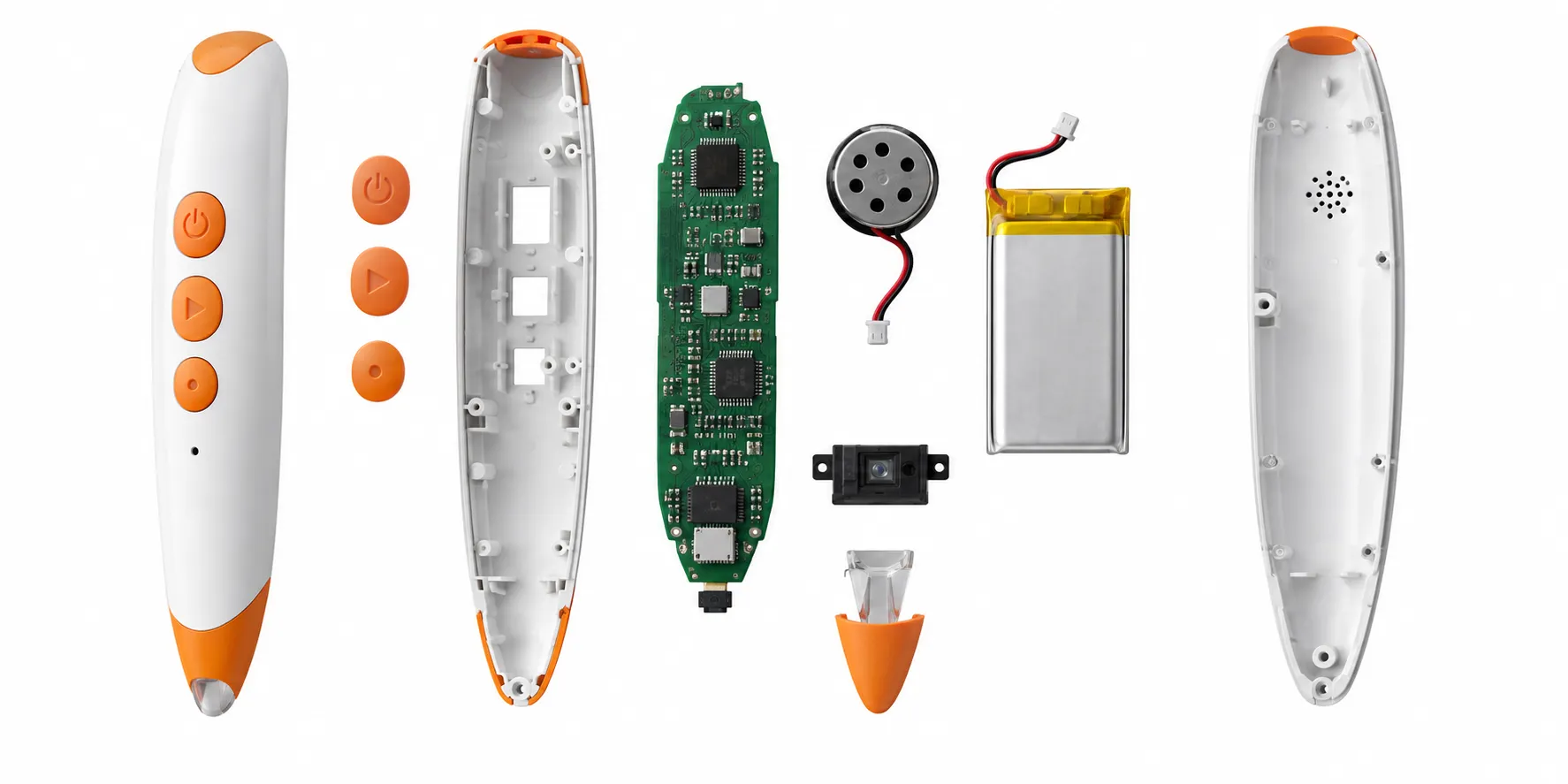
The tip of a talking pen is a wear surface, an optical spacer and an impact-protection feature at the same time. For a B2B buyer, the useful question is not whether a supplier can demonstrate the feature once. The question is whether the promised result can be defined, approved, reproduced during mass production and identified again when a shipment or reorder is reviewed.
This guide is intended for talking pen brands, publishers and sourcing engineers reviewing enclosure tooling or field failures. It treats talking pen tip durability as a connected product, manufacturing and evidence decision. The recommendations are practical starting points, not substitute legal opinions or universal numerical limits. Intended age, destination market, construction, content and sales channel must be reviewed for the actual project.
The approach reflects the work normally required between an early buyer brief and shipment release: clarify customer requirements, challenge foreseeable failure modes, build a production-intent sample, document factory testing, prepare line controls and retain enough identity information to investigate later feedback.
How should a talking pen tip be designed and tested?
A talking pen tip should maintain the validated sensor-to-page distance, avoid damaging printed surfaces, resist foreseeable wear and drops, protect the optical window and remain inaccessible as a hazardous small part for the intended age. Test recognition and physical condition before and after representative abrasion, pressing, twisting and impact sequences on production-intent material.
Decide whether the tip is a fixed enclosure feature, a captured insert or a controlled service part; consumer replacement adds access, misuse and compatibility questions. A strong decision states the starting condition, user action, expected response and acceptable evidence. Words such as “easy,” “durable,” “clear,” “safe” or “accurate” are useful goals, but they cannot release a sample until the parties agree how those goals will be observed.
The first risk review should cover tip abrasion changing working distance, insert loosening after repeated contact, drop impact shifting the optical module, and rough edges marking books. These are not merely inspection defects. Each risk needs an owner and a control point: design prevention, supplier qualification, sample validation, production screening, shipment inspection or post-market traceability.
1. Turn the buyer request into an approval brief
Define the intended page materials, contact force, child age, cleaning method, expected service life and whether the tip is replaceable only by service personnel or by the customer. Begin with the intended child, supervising adult, learning activity, environment and market claim. Then describe the sellable set: product, content, accessories, power items, instructions, packaging and language. A factory cannot quote one stable configuration when these boundaries remain implicit.
Separate mandatory requirements from preferences and future ideas. A mandatory point affects acceptance of the current order. A preference may be optimized during sampling. A future idea belongs in the architecture discussion but should not silently increase current cost, memory, tooling or schedule.
Record who supplies artwork, audio, translations, test samples, compliance decisions and final approvals. Also record quantity, SKU count, target Incoterm, destination, launch window and the date at which files become final. These commercial facts influence the technical route and should be visible before the purchase order.
2. Review the decisions that control the user experience
Tip length, bore, surface finish, resin, retention, sensor seating and lens position form a tolerance chain that determines both page contact and optical working distance. Review the interfaces between mechanical parts, electronics, firmware or content, printed material and packaging. Many field problems occur at an interface even though every individual component passed its own incoming check.
Ask the supplier to distinguish an existing proven platform from configurable work and genuinely new engineering. An existing mold does not prove a new button map, content package, sensor target, battery arrangement or package set. Changed functions deserve a proportionate validation plan.
Choose a durable contact geometry
Round edges and a suitable contact area can reduce page damage, but the geometry must not block the sensor field or encourage an unstable pen angle.
For sample approval, connect this decision to “Optical working distance remains within the validated range” and retain tip and optical tolerance drawing. Challenge the difficult case associated with tip abrasion changing working distance instead of recording only a successful ideal demonstration.
Protect the optical stack from impact
Use housing support and controlled gaps so a tip impact does not shift the lens, illumination or sensor beyond the calibrated range.
For sample approval, connect this decision to “No sharp edge, hazardous fragment or accessible part after tests” and retain material and retention specification. Challenge the difficult case associated with insert loosening after repeated contact instead of recording only a successful ideal demonstration.
Control replacement access
If replacement is allowed, define the tool, part identity, retention verification and post-replacement recognition check. Avoid an attractive detachable part for young children.
For sample approval, connect this decision to “Page contact does not cause unacceptable marking” and retain pre/post durability recognition report. Challenge the difficult case associated with drop impact shifting the optical module instead of recording only a successful ideal demonstration.
3. Convert likely failures into measurable checks
Failure analysis should describe what the user observes, the probable mechanisms and where evidence can separate them. “Does not work” is too broad for corrective action. A useful report identifies the unit and lot, starting state, repeated action, observed output, environment, media or accessory used, and whether the issue follows the product or the test condition.
Prioritize failures by consequence, probability and detectability. A rare cosmetic variation and a less visible loss of a safety-related function should not be managed with the same sampling rule. For children’s electronic products, also consider predictable misuse, repeated operation, low-battery behavior, partial assembly, wrong content or SKU, and changes introduced by packaging or transport.
Do not confuse a specification with a test method. The specification describes the acceptable outcome; the method explains how evidence is produced. Keeping them separate allows an equivalent or improved method to be reviewed without silently changing the product requirement.
| Decision area | Acceptance question | Evidence to retain |
|---|---|---|
| Choose a durable contact geometry | Optical working distance remains within the validated range | tip and optical tolerance drawing |
| Protect the optical stack from impact | No sharp edge, hazardous fragment or accessible part after tests | material and retention specification |
| Control replacement access | Page contact does not cause unacceptable marking | pre/post durability recognition report |
4. Validate the production-intent sample before mass materials
Build tips from production resin and process because machined prototypes may wear and flex differently. Test on representative coated and uncoated pages and preserve failed samples for sectioning or dimensional review. Use an early engineering build to answer the highest-risk unknowns, even if color or packaging is temporary. Mark temporary components and simulated behavior clearly. A beautiful sample can still be technically provisional, while an unfinished engineering unit can provide valuable evidence about the architecture.
The integrated approval sample should use production-intent critical parts, files, artwork, content and interaction logic. Review it against a dated checklist. Every failed item needs a clear symptom, owner and disposition; the next build should identify which corrections were implemented and which dependent checks were repeated.
A golden sample is a configuration reference, not a substitute for drawings, bills of material or files. Identify model and SKU, hardware revision, firmware or content release, artwork and packaging revision, accessories and approved deviations. Store photographs and test records with the sample so future reviewers understand what it represents.
Measure physical change and functional recognition together. A tip can appear intact yet move the optical plane enough to reduce reading margin near gutters or at normal hand angles. The core program should include Measure tip dimensions and assembled working distance, Cycle controlled page contacts on representative surfaces, Apply relevant pull, twist and compression checks, and Perform oriented drops including tip-first impacts. Define conditioning, repetitions, sample quantity and pass criteria according to project risk. If a numeric limit is required, derive it from the intended use and applicable requirements rather than copying an unrelated competitor specification.
- Measure tip dimensions and assembled working distance
- Cycle controlled page contacts on representative surfaces
- Apply relevant pull, twist and compression checks
- Perform oriented drops including tip-first impacts
- Inspect optical window and housing after conditioning
- Repeat OID recognition across angles and page locations
5. Translate approval evidence into factory controls
Control molded dimensions, resin, insert seating, sensor position and fastening. First-off and periodic checks should challenge both retention and recognition. A factory control plan should make molded tip dimension inspection, approved resin and finish identity, insert seating and retention check, and optical module position control visible to purchasing, assembly and quality teams. The approved result must survive incoming inspection, first-off setup, in-process handling, final functional checks and pack-out.
Use controlled work instructions and verified fixtures. Where a result depends on reference files, test media, firmware or threshold settings, identify their versions at the station. A drifting fixture or obsolete file can consistently approve the wrong output, so challenge the system with a known reference and retain the result.
Line screening and shipment inspection serve different purposes. Screening finds assembly or programming errors efficiently. Shipment inspection samples the completed lot across cartons, production periods and pallet positions. It should confirm product identity, critical functions, appearance, accessories, labels, language and packaging as one sellable configuration.
When a defect appears, contain related material by lot and production time, reproduce the symptom, identify the mechanism and verify the correction. Reworking the visible defect without finding its source may release the same problem again in the next carton or reorder.
- molded tip dimension inspection
- approved resin and finish identity
- insert seating and retention check
- optical module position control
- reference-page recognition screen
- sampled post-drop or wear audit
6. Ask suppliers for evidence, not broad assurances
Ask the supplier to show the tolerance relationship between the tip and optical path and provide post-conditioning recognition data, not only an unbroken drop-test sample. A capable supplier can explain assumptions, limits, open risks and the next verification step. “No problem” is not evidence. Ask for the build version, sample quantity, fixture or method, outcome, failure disposition and record owner behind each important claim.
Compare quotations using the same sellable set and responsibility matrix. Engineering, tooling, samples, content work, printing, packaging, laboratory assessment, fixtures, inspection and delivery terms may be included differently. Unit prices are not comparable when the underlying scope is different.
Schedule approval work explicitly. Separate buyer review time, supplier engineering, correction cycles, component purchasing, print production, laboratory lead time, pilot build, shipment inspection and booking. This makes the true critical path visible and prevents a quoted production lead time from hiding unresolved pre-production work.
| Commercial decision | Confirm in writing | Risk if omitted |
|---|---|---|
| Construction | Integral, captured or replaceable tip | Tooling or service complexity |
| Durability | Conditioning and recognition criteria | Warranty reading failures |
| Replacement | Part supply and user controls | Wrong or loose spare parts |
7. Protect the shipment and the next reorder
Archive tip drawings, resin, tooling cavity, optical components and durability baselines. Inspect returned pens for wear pattern and compare it with retained samples. The release index should make tip and optical tolerance drawing, material and retention specification, pre/post durability recognition report, and drop and abuse condition record easy to retrieve. Purchasing, engineering, quality and a third-party inspector should reach the same approved identity without reconstructing a decision from scattered messages.
For shipment inspection, select a representative sample from finished cartons and verify critical functions in the final packed condition. Include set completeness, correct language and SKU, label information and barcode readability where relevant. Record actual findings and photographs rather than only a pass statement.
Before a reorder, compare the current suppliers, bill of material, drawings, tooling status, firmware or content, artwork, labels, test methods and destination-market assumptions with the archived release. Any substitution needs an impact assessment, approval owner and proportionate revalidation before it enters production.
Customer feedback should capture product identity, lot or traceability mark, market, use condition and reproducible symptom. Compare reports with retained samples and production records. Avoid claiming a root cause before evidence supports it, and avoid dismissing a low-frequency report when its consequence warrants investigation.
Minimum shipment-release pack
Keep the approved sample index, controlled specification, current files, critical component identities, line-test summary, inspection result and accepted deviations together. Define how long records and retained samples will be kept according to the buyer’s legal and commercial needs.
A deviation must state what differs, the affected quantity, evidence reviewed, approver and whether the permission is limited to one lot. Otherwise a temporary concession can become an uncontrolled permanent specification.
Change triggers
Review changes to materials, component supplier, manufacturing site, tooling, software, audio, translation, print process, coating, battery, package, warning, age claim or target market. Not every change requires every test, but each requires a documented impact decision.
Visible appearance may remain identical while electronic or content performance changes. That is why an approved photo alone cannot control a children’s learning product across repeated orders.
8. Use a practical buyer action plan
Add the exact page surfaces and tip-first impact orientations to the sample plan before approving enclosure tooling. Create a four-column tracker: requirement, current decision, evidence still needed and responsible owner. Review it at quotation, engineering sample, integrated sample, pilot build and shipment release. Unresolved items should remain visible instead of disappearing into general meeting notes.
Send suppliers the difficult use case, not only the feature list. Ask them to show how the product behaves at boundary conditions and how the factory will distinguish a correct unit from a plausible-looking failure. This produces more useful technical discussion and more comparable quotations.
Before placing the production order, reconcile the quotation, purchase specification, approved sample, bill of material, file manifest, package list, inspection plan and compliance responsibility matrix. Together they should describe one buildable and saleable configuration.
Frequently asked questions
Should a talking pen tip be replaceable?
Only when the service benefit justifies the added access and compatibility risks. The intended age and applicable requirements must be considered.
Can a worn tip cause missed reads?
Yes. Wear can change working distance, angle or lens protection even when the electronics remain functional.
Is a soft tip always better for books?
Not necessarily. Material, geometry, friction, wear particles and optical clearance must be evaluated together.
How many contact cycles are enough?
Set cycles from the expected use profile and risk. Use them as an engineering target, then inspect and retest recognition rather than relying on cycle count alone.
Why test different page coatings?
Coatings change friction, reflection and visible marking, so a tip validated on one paper may behave differently on the finished book.
What should shipment inspection check?
Check tip presence, seating, finish, recognition and visible damage; periodic audits can cover deeper retention or impact tests.
Conclusion
A durable pen tip protects both the book and the optical margin. Treating geometry, material, retention and recognition as one design prevents a small part from becoming a large field problem.
A defensible talking pen tip durability decision connects real customer requirements with production-intent validation, factory controls, shipment evidence and reorder traceability. Share the intended user, product set, languages, target markets, expected quantity and launch timing for a focused OEM review.
Authoritative references
Requirements change and differ by product. Use the current official source and qualified professional advice for the final project.