
Talking Pen Battery Design: Rechargeable vs Replaceable Power
A decision framework for choosing power architecture without relying on unsupported runtime or universal safety claims.
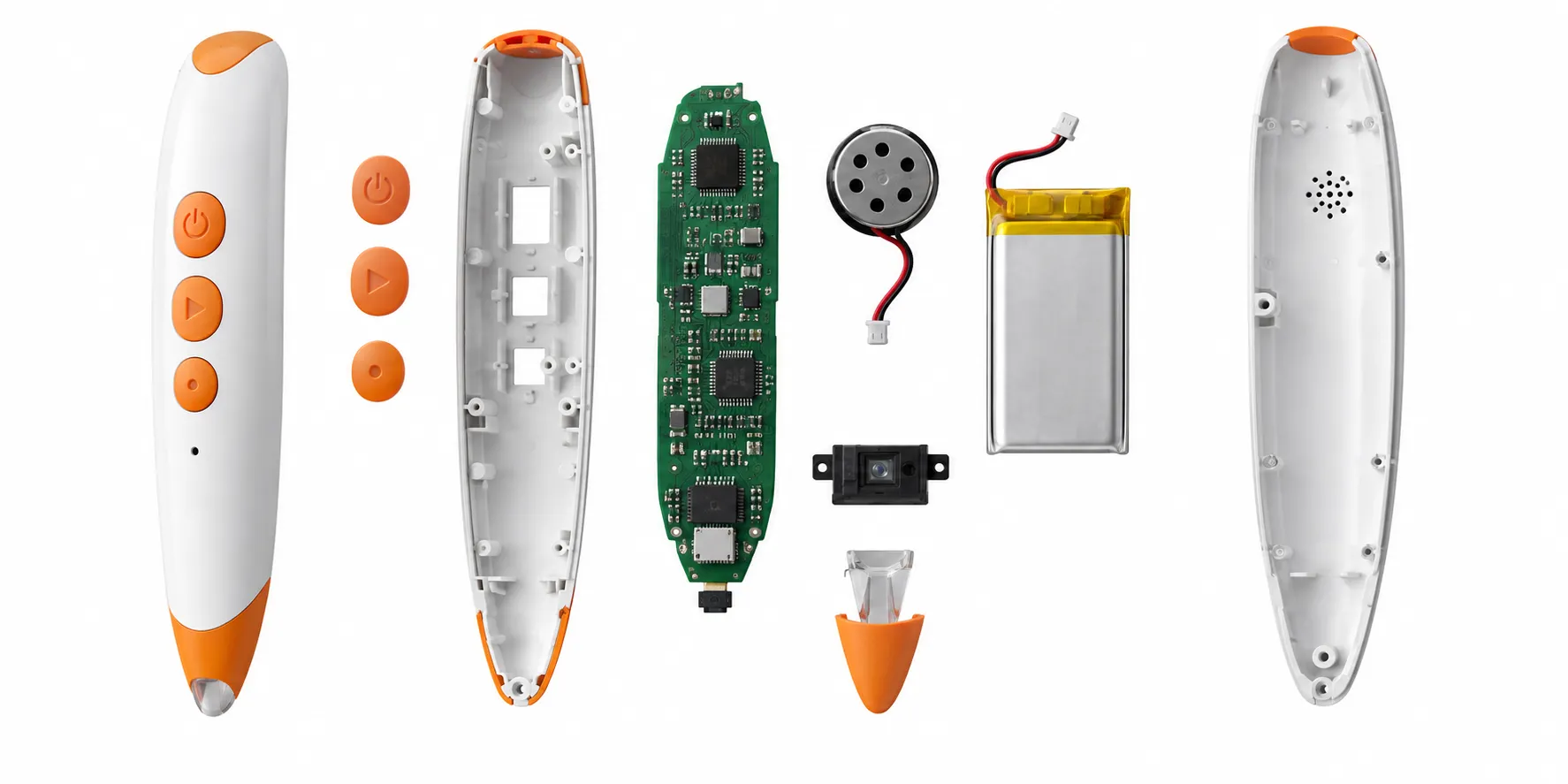
Rechargeable and replaceable battery talking pens solve different customer problems. Rechargeable designs can reduce routine battery purchases and support a sealed form, while replaceable cells can simplify field replacement and avoid waiting for charging. Neither option is automatically safer, cheaper or more sustainable in every configuration.
Runtime claims are only meaningful under stated conditions. Audio volume, playback pattern, sleep current, sensor use, indicator behavior, cell quality and temperature all affect results. A buyer should approve the complete power experience rather than compare capacity numbers alone.
This guide covers product and sourcing decisions. Battery safety, transport and market compliance require configuration-specific review by qualified parties using current rules.
Should a talking pen use a rechargeable or replaceable battery?
Choose a rechargeable talking pen when convenient charging, compact integration and controlled cell selection fit the user and logistics plan. Choose replaceable batteries when immediate field replacement, long storage or institutional maintenance is more important. In both cases, validate runtime, access, protection, low-power behavior, production traceability, package information and market-specific requirements on the final product.
Begin with the user setting. A home product may be charged by a caregiver, while a classroom fleet may need rapid turnaround or centralized charging. A travel or retail product may prioritize storage readiness. Define who manages power, how often the pen is used and what happens when energy is low.
Then review the product lifecycle. Rechargeable cells age and require controlled charging and transport evidence. Replaceable cells require secure access, polarity control and clear replacement instructions. Consumable availability varies by region, and included cells change packaging and shipment assumptions.
1. Compare user experience and maintenance
A rechargeable pen needs an accessible connector, clear charge indication and a cable or stated compatible input. Charging should not create confusing operation, exposed damage risk or unsupported caregiver assumptions. Decide whether the pen works while charging and how the product communicates completion and faults.
A replaceable-cell pen should make caregiver replacement understandable while restricting child access as required for the design. Battery orientation, contacts and compartment fasteners need robust engineering. Test repeated authorized replacement and foreseeable incorrect orientation.
2. Define a repeatable runtime test
Specify cell condition, volume, audio cycle, touch frequency, idle periods, room conditions and endpoint. Continuous playback may be easy to compare but may not represent normal learning use. Use at least one repeatable engineering cycle and one realistic user scenario.
Record low-power warnings and usable performance near the endpoint. A pen that becomes quiet, slow or inaccurate before shutdown may create poor experience even if total hours look attractive. Test sleep drain and storage retention separately from active runtime.
3. Review cell, circuit, connector and enclosure as one system
For rechargeable products, confirm approved cell model, protection, charging circuit, temperature conditions, connector, cable and firmware thresholds. Mechanical restraint should prevent movement, pinching and screw damage. The final enclosure affects heat and accessibility.
For replaceable products, define approved cell type, contact pressure, polarity protection, door design and fastener retention. Do not mix cell chemistries or sizes through vague labeling. Evaluate drops and repeated handling with installed cells.
4. Plan packaging, storage and international shipment
Installed lithium batteries and spare batteries can create different transport classifications and documentation needs. Confirm watt-hour rating, UN 38.3 test summary and package arrangement with qualified freight partners before booking. Carrier requirements can differ by route.
Replaceable alkaline or other cells also require accurate product and package information. Decide whether cells are included, installed, insulated or sourced locally. Storage time and leakage risk should be addressed through approved suppliers, incoming controls and inventory rotation.
5. Compare total cost instead of cell price
Rechargeable cost includes cell, charging electronics, connector, cable, assembly, evidence and potential service. Replaceable cost includes compartment hardware, included cells if any, stronger labeling and consumer replacement over time. Packaging and freight may change the comparison.
Model warranty and support. A sealed cell that cannot be serviced may shorten perceived product life, while a poorly designed battery door may create returns. The right decision protects the intended product life and channel economics, not only the first factory quotation.
6. Control battery configuration in production and reorders
Approve supplier, model, capacity, dimensions, protection and connector for rechargeable cells, or brand/type requirements for included replaceable cells. Incoming inspection should verify identity, voltage, polarity, condition and traceability. Prohibit substitution without documented review.
Final testing should confirm installation, charge or power-on behavior, indicators, low-power response and representative operation. Link battery lots to finished goods. Recheck evidence and packaging when the cell, charger, cable or power firmware changes.
| Decision area | Rechargeable focus | Replaceable focus |
|---|---|---|
| User task | Charge and interpret indicators | Open, orient and secure cells |
| Hardware | Cell plus charging path | Contacts plus restricted access |
| Logistics | Lithium transport evidence | Included-cell declaration |
| Service | Capacity aging and replacement policy | Cell availability and leakage control |
Implementation record: applying talking pen battery design to a real project
Start with a controlled baseline, not an informal sample
For a talking pen power design project, the first useful baseline combines the written requirement, approved physical sample, product configuration, content release and test evidence. Photographing a sample or calling it “approved” is not enough. Record its model, language, firmware or content identity where relevant, materials, accessories, package version and any accepted deviation. The baseline gives purchasing, engineering, the factory line and the shipment inspector the same reference when talking pen battery design decisions move from discussion into production.
Run a short cross-functional review before freezing that baseline. The buyer should confirm customer requirements and target market; engineering should identify technical constraints and dependencies; quality should convert critical promises into observable checks; and production should confirm that the proposed method can be repeated at line speed. Open points need an owner and due date. If an assumption cannot yet be verified, label it as provisional instead of allowing it to appear as an approved fact in the quotation or instruction.
Use pilot evidence to expose variation and handoff errors
A pilot is most valuable when it reproduces the intended materials, tools, files, operators, inspection steps and packing flow. Select units from the beginning, middle and end of the run, then test normal use and the difficult conditions identified in the risk review. Record individual results rather than only writing “pass.” For electronic learning products, useful evidence may include version identity, response behavior, audio clarity, power state, repeated interaction and pack-out accuracy, depending on the subject of the article.
Review failures by mechanism and process stage. A symptom found during factory testing can originate in an incoming component, file release, assembly method, fixture, work instruction or inspection rule. Correcting only the failed unit does not demonstrate control. The team should document containment, determine the likely cause, update the source process and rerun a defined verification sample. When evidence is mixed, keep the conclusion narrow and collect more data rather than making a confident but unsupported claim.
Carry the approved decision through shipment and repeat orders
Before shipment inspection, translate the approval package into a concise inspection plan. It should identify critical functions, sample selection, test media or fixtures, cosmetic limits, packaging checks, version verification and the records that must accompany the lot. Random sampling can indicate lot quality, but it does not replace process controls for safety-critical or configuration-critical characteristics. Define any 100 percent checks separately and confirm that their fixtures and pass criteria are controlled.
For reorders, begin from the archived release rather than from a fresh verbal description. Compare the bill of materials, approved suppliers, files, firmware, artwork, labels, test methods and regulatory assumptions. Any proposed substitution should state why it is needed, what characteristics may change and what revalidation is required. This disciplined comparison protects customer requirements when staff, component availability or production timing changes between orders.
Finally, use field feedback as structured input. Record model, lot, market, usage conditions and symptom; compare the report with retained samples and production records; and separate isolated damage from a repeatable pattern. The purpose is not to claim that every project is risk-free. It is to create traceable evidence showing what was specified, what was tested, what was shipped and how new information was handled. That is the practical foundation of trustworthy talking pen battery design guidance.
Create a buyer review worksheet before quotation
A useful review worksheet has four columns: requirement, current decision, evidence needed and responsible owner. Populate it first with the six target areas that commonly change a children’s electronic product: user and age, interaction, content and language, hardware and power, package configuration, and destination market. Add the subject-specific decisions from this guide. For each row, state whether the item is approved, open, supplier-proposed or outside the current scope. This prevents an unanswered question from silently becoming a factory assumption and makes different quotations easier to compare.
Use the worksheet during the sample meeting rather than relying on comments scattered across email and chat. Link each decision to a dated file, marked photograph, measured result or physical reference. When the buyer accepts a deviation, record what differs, why it is acceptable and whether labeling, instructions, testing or price changes. Before issuing the purchase order, reconcile the worksheet with the quotation, approved sample and pack-out list. The result should identify one buildable configuration, not a collection of individually approved materials that were never reviewed together.
Add a final column for change triggers. Examples include a different component supplier, edited audio, new language, revised printed content, new package claim, destination-market change or a manufacturing-site move. For every trigger, identify who reviews the impact and which sample, document or test may need to be repeated. This turns the worksheet into a lifecycle control rather than a one-time RFQ form. It also gives customer service and reorder teams a faster route back to the evidence behind the released product. Record the decision date and effective production lot so warehouse stock, shipment inspection and later complaints can be compared with the correct configuration across changing commercial production conditions.
Frequently asked questions
How long should a talking pen battery last?
There is no universal runtime. Define volume, content cycle, touch frequency, sleep behavior, cell condition and endpoint, then test the final configuration.
Is a rechargeable talking pen safer?
Safety depends on the complete design, approved components, protection, enclosure, firmware and compliance evaluation. Battery type alone does not prove safety.
Can the same pen offer both battery options?
Sometimes, but the enclosure, PCB, contacts, firmware, reports and packaging may differ. Treat each as a controlled configuration.
Is USB-C required for a rechargeable pen?
Connector choice depends on design and market requirements. Confirm current applicable rules, charging input, cable and user instructions with qualified parties.
What battery documents are needed for shipping?
For lithium configurations, carriers commonly require accurate battery information and a valid UN 38.3 test summary. Requirements depend on shipment mode and package arrangement.
Can a factory substitute an equivalent cell?
Only after documented engineering, quality and compliance review confirms suitability and any needed revalidation. Equivalence should not be assumed from capacity alone.
Conclusion
Talking pen battery design is a user, engineering and logistics decision. Rechargeable and replaceable systems can both be appropriate when the complete power path and maintenance model are defined.
Approve measurable runtime conditions, control the exact configuration and plan transport and service before mass production. That produces a more credible specification than a battery-life claim without context.
Authoritative references
Requirements change and differ by product. Use the current official source and qualified professional advice for the final project.