
How to Customize a Talking Flash Card Machine: An OEM Buyer’s Guide
A practical guide for educational brands and importers defining card recognition, audio content, reader hardware, packaging and production quality before requesting an OEM quotation.
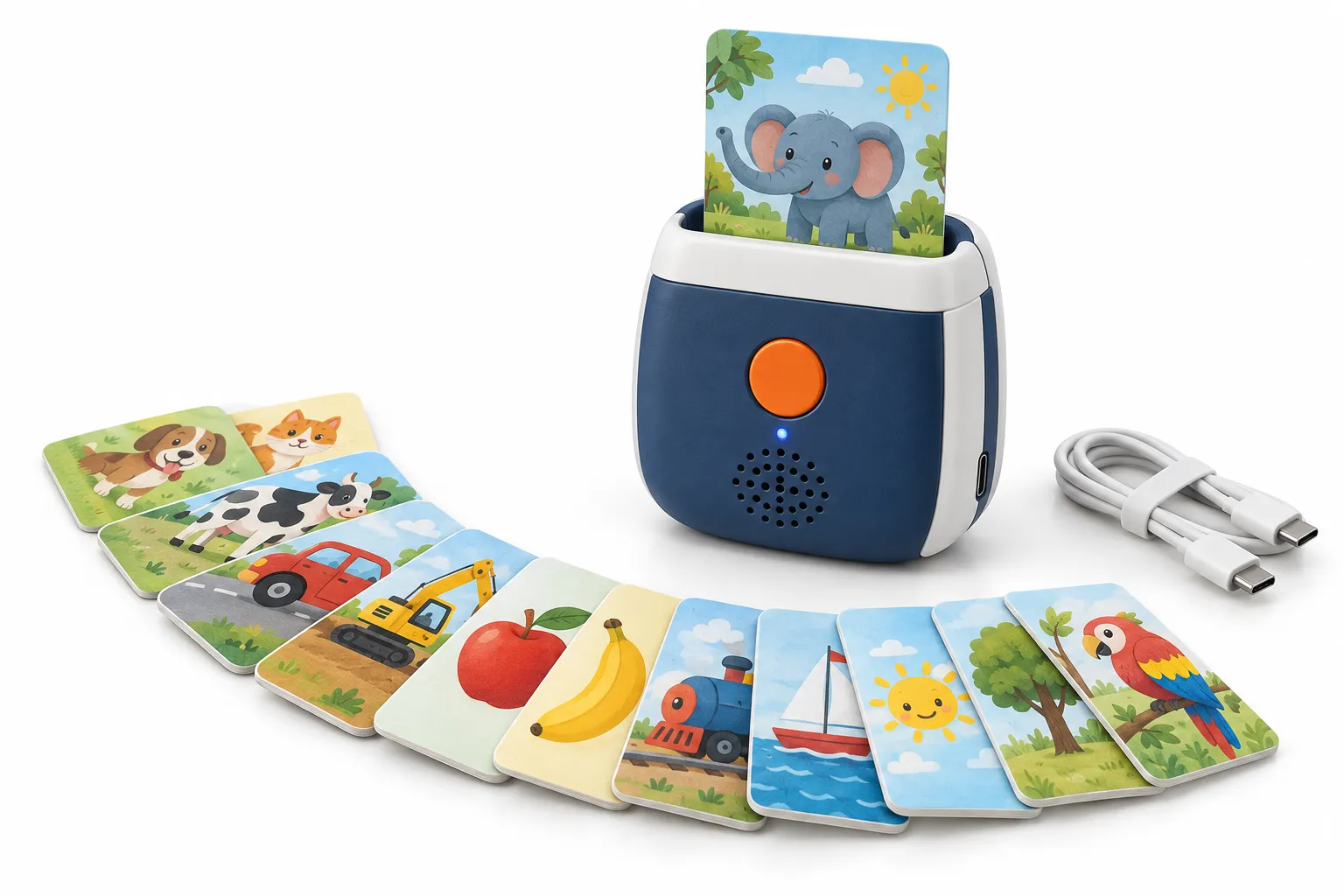
A talking flash card machine is a compact audio learning device that identifies an inserted or presented card and plays the corresponding word, phrase, sound effect or instruction. The product appears simple, but a successful OEM order depends on five connected elements: the card identifier, printed artwork, audio map, reader electronics and final pack-out.
Many sourcing problems begin when buyers request only a housing color, logo and card quantity. Two factories may quote products that look similar while using different recognition methods, card tolerances, memory configurations, speakers, batteries and programming workflows. A low initial quotation may exclude custom audio processing, card artwork, compliance testing or the final inspection standard.
This guide helps toy brands, education companies, distributors and importers create a comparable brief and evaluate evidence from sample through shipment. It focuses on testable specifications rather than unverified claims about learning outcomes, minimum order quantities or universal certificates.
What is a talking flash card machine?
A talking flash card machine is an electronic reader that detects a card identifier and plays mapped audio from internal memory. A dependable OEM set requires readable cards, controlled code-to-audio mapping, clear speech, child-appropriate reader construction and production tests that verify the correct card, language and audio response.
The learner usually inserts a card into a slot, taps it to a reader or places it within a defined sensing area. The device identifies a printed, punched, magnetic, contact, optical or radio-based code depending on the platform. Firmware then maps that identifier to a stored audio file. Some products add repeat, volume, language, quiz or music functions.
The machine should be evaluated as a complete set. A reader can pass a power-on test while failing with cards that are cut slightly off-center. A card can look attractive but carry the wrong identifier. A correctly programmed unit can still be packed with the wrong language deck. The quality plan must connect all components.
The best talking flash card machine is not the model with the longest feature list. It is the platform whose recognition method, card construction, audio capacity and test process match the intended content, age grade, market and order configuration.
1. Define the product brief before comparing factories
Start with the product application. A first-word set may use one image and one pronunciation per card. A bilingual set may play two languages sequentially or use a language selector. A phonics product may need letter sounds, example words and repeat behavior. A classroom pack may require organized topic decks and easy replacement of lost cards.
State whether a card has content on one or both sides. Some readers identify the inserted edge while the artwork side faces the learner; others can distinguish both orientations. If both sides are used, confirm how the system detects side A and side B and how artwork orientation prevents accidental reversal.
Define customer requirements that affect quotation: intended age, card count and topics, languages, audio duration, reader size, power system, accessories, package type, quantity, destination markets and launch window. Mark which elements are fixed and which the manufacturer may recommend.
Choose a realistic customization route. Private label can use an existing validated reader and card format with new logo, audio, artwork and package. A modified platform might change memory, speaker, controls or housing details. A full custom product may require industrial design, tooling, electronics and firmware. These routes create different costs, schedules and compliance work.
| Brief item | Buyer decision | Why it affects manufacturing |
|---|---|---|
| Card library | Number of cards, sides and topics | Defines identifiers, printing and pack-out |
| Audio | Languages, file types and playback behavior | Defines memory, mapping and recording work |
| Reader | Existing, modified or custom | Defines tooling, engineering and validation scope |
| Power | Replaceable or rechargeable | Changes construction, accessories and test plan |
| Market | Country, channel and age grade | Guides labels, documentation and compliance review |
2. Choose and validate the card recognition system
Select a card recognition system by comparing read reliability, card cost, identifier capacity, orientation tolerance, artwork constraints and future expansion. Validate it with production-representative cards across the slot or sensing area, not only with a hand-prepared engineering card.
Edge-pattern systems identify features printed, punched or otherwise encoded near the card edge. They can support economical card sets, but card dimensions, cut position and insertion depth must remain controlled. Optical systems may read printed identifiers, while contact or radio-based approaches use different component and encoding requirements. The supplier should explain the actual method without exposing proprietary details that are unnecessary for the buyer's approval.
Ask how many unique identifiers are available and how they are allocated. Confirm whether future decks can use the same reader, whether identifiers are exclusive to the buyer and what happens when the original set expands. Code ownership and compatibility should be documented, especially when a brand expects repeat orders or multiple language editions.
Recognition tolerance must be demonstrated. Test cards at the allowed dimensional limits, with normal print variation and repeated insertion. Observe partial insertion, fast insertion, reverse orientation and card changes during playback. Firmware should return to a predictable state rather than playing the previous card or an unrelated file.
The recognition specification belongs in the approved configuration. A supplier should not change the sensor, card code method, critical dimensions or firmware interpretation without review. Even if the consumer appearance is unchanged, those changes can affect every card in the library.
| Recognition factor | Buyer question | Useful evidence |
|---|---|---|
| Read zone | Where and how must the card be presented? | Marked sample and insertion demonstration |
| Tolerance | Which card dimensions and positions are acceptable? | Drawing plus boundary-condition samples |
| Capacity | Can future decks receive new IDs? | Allocation plan and compatibility statement |
| Orientation | Can the reader distinguish sides or directions? | Test matrix for valid and invalid insertion |
| Change control | What recognition elements may not be substituted? | Controlled specification and approval process |
3. Engineer the card library, artwork and audio together
Create a master content map before final artwork or recording. Each card side should have a unique ID, topic, displayed word, image reference, audio script, language, pronunciation note, sound effect, playback rule, code assignment and approval status. This becomes the shared reference for authors, illustrators, translators, audio engineers, firmware developers and inspectors.
Card design must support recognition and handling. Use the manufacturer's approved card dimensions, corner radius, safe area and code zone. Keep critical text and faces away from the insertion slot if that area becomes hidden. If lamination, varnish or a special surface is proposed, confirm that it does not interfere with the recognition method or create unacceptable edge behavior.
Images should be accurate, culturally suitable and licensed for physical product use. For vocabulary products, avoid ambiguous illustrations that could represent more than one word. Maintain a terminology sheet so the printed word, recorded pronunciation, package description and marketing content remain consistent.
Audio files need stable names and statuses. Record representative samples before the full library to approve voice, pace, pronunciation, silence, effects and volume. Device-ready audio should be checked on the actual reader because a small speaker and enclosure reproduce files differently from studio headphones.
Installation preparation should freeze the content map, audio package, firmware and SKU before programming. A bilingual set, for example, needs a documented rule for language selection and a defined package identity. The factory should not assemble mixed revisions from email attachments or unapproved folders.
4. Specify the reader hardware and firmware with measurable behavior
Document the housing, controls, recognition module, processor, memory, speaker, power source, charging interface if used, indicators and accessories. The buyer does not need to dictate every component, but the approved configuration should identify safety- and performance-relevant parts and require notification before substitution.
Memory should be sized from the real content package rather than a generic card count. File duration, language count, format, bitrate, music and reserved capacity all influence the requirement. Ask for the proposed device-ready package size and a reasonable expansion plan if future decks are part of the business model.
Audio clarity must be judged in the finished enclosure. Test the shortest word, similar-sounding terms, long phrases, music and sound effects at each permitted volume. The CPSC directs manufacturers and importers of sound-producing toys to review applicable ASTM F963 sound and volume requirements. The responsible business should establish the correct measurement and test scope for the specific product.
Firmware behavior should cover startup, card insertion, repeat, language or mode switching, volume, card removal, rapid changes, inactivity, low power and shutdown. Give each release a version. The factory needs a controlled programming master and a way to verify that the correct build is installed on the correct SKU.
Power claims require test conditions. Define cell type or initial charge, representative playback cycle, volume, indicator use and idle periods. For rechargeable models, review the cell, protection, charging connector, cable and transport documentation. Electrical safety requirements should be confirmed for the final market and configuration.
5. Approve cards, audio and reader samples in stages
A stock reader sample can confirm general size and platform behavior before custom files are ready. A content sample should then use a small but representative card set: different topics, both sides if applicable, short and long audio, each language and each operating mode. This reveals mapping and recognition issues before the entire library is printed or recorded.
Use a digital proof for text and layout, but approve physical card samples for dimension, cut, finish, insertion and recognition. Digitally printed prototypes may differ from the mass process, so record the limitation. If a new housing or color is involved, review an appearance sample separately from function so cosmetic approval does not hide temporary electronics.
The preproduction or pilot set should represent the final reader, cards, audio, firmware, labels, accessories and package. Test multiple sets assembled through the intended process. Confirm that operators can program, test and pack the correct version using released instructions.
Maintain an approved reference set with the device, representative cards, complete content map, firmware and audio version, artwork, packaging and deviation list. New customer requirements should enter a change record that identifies affected files, sample needs, cost, timing and compliance review.
A flash card sample is approved only when the card ID, printed concept and played audio are approved together—not when each component looks correct in isolation.
6. Plan factory testing around the complete learning set
Factory testing for a talking flash card machine should verify reader identity, firmware and audio version, controls, recognition across representative card IDs, speaker output, power behavior and card pack-out. Card dimensions, print, code position and deck completeness also require controlled inspection.
Incoming inspection may confirm critical reader components, batteries, printed card sheets and packaging materials against the approved bill of materials. Card production controls should check registration, code position, die cutting, corner condition, finish and collation. A visually acceptable card can still fail if its identification edge shifts beyond the reader's tolerance.
First-article inspection should occur before a full run continues. Verify reader assembly, sensor position, controls, programming, appearance and the first finished card decks. If the first article requires manual adjustment, correct the process and repeat the approval rather than treating the workaround as normal production.
Unit-level function testing should exercise every reader input and a controlled group of card IDs that proves the sensor, mapping, audio, speaker, volume and power behavior. The complete master content package should be validated before release. Use sampling or automated methods appropriate to the library while ensuring high-risk or easily confused mappings receive deliberate coverage.
Deck collation needs its own control. Count cards, verify topic ranges and language, and use a visual or code-based method to prevent duplicates and missing cards. Inspect retail-pack contents against an approved arrangement so cables, manuals, card rings or storage accessories are not omitted.
- Reader model, color and programmed SKU
- Recognition response at defined positions and orientations
- Correct card-to-audio mapping and language behavior
- Buttons, volume, speaker, indicators and power functions
- Card size, cutting, print, finish and deck completeness
- Labels, manual, accessories, retail box and shipper carton
7. Compare OEM quotations and supplier capability
Send one written brief to every shortlisted supplier. The quotation should state reader platform, card format and count, audio and language scope, customization, packaging, testing and included development work. Separate one-time items—new molds, artwork adaptation, audio processing or fixtures—from recurring unit cost.
Minimum order quantity may be driven by electronics purchasing, housing color, card printing, lamination, package setup or factory scheduling. Ask which item creates the constraint. An existing reader with a custom card deck may support a lower-risk launch than a fully custom shell, while still giving the brand meaningful differentiation through content and packaging.
Ask the manufacturer to demonstrate one real workflow: receive a content row, assign a card ID, process the audio, program the reader, produce the card and verify the response. Review the files and records used. This evidence is more useful than an unsupported claim that the factory can make any language or card quantity.
Compliance evidence must match the proposed configuration and market. A report for a similar reader may not cover a new battery, material, accessory, age grade or construction. Define the roles of factory, brand owner, manufacturer and importer, then obtain product-specific advice from qualified laboratories or compliance professionals.
8. Prepare a shipment inspection that catches configuration errors
Shipment inspection should use finished, packed goods selected across available cartons under an agreed sampling and acceptance plan. Inspect product identity, quantity, workmanship, function, card deck, language, accessories, labels, retail package and shipping cartons against the approved specification and reference set.
Functional sampling should include cards from the beginning, middle and end of identifier ranges and any easily confused pairs. Test both sides where applicable, each language or mode, repeat, volume, audio clarity, charging or battery behavior and inactivity. Confirm the installed content version using the method defined in the quality plan.
Inspectors should not rely only on a supplier-prepared demonstration set. They should draw units and decks from finished cartons. If a configuration defect is found, isolate the affected lot and investigate the scope. Replacing the sampled card does not prove that the remaining cartons contain the correct deck.
A passed shipment inspection is a sample-based release check, not a substitute for product compliance, process control or master-content validation. Its value is strongest when the criteria, defect classes and response to failure were agreed before production.
Frequently asked questions
What can be customized on a talking flash card machine?
Common options include reader color and logo, card topics and artwork, audio, languages, controls, memory, accessories, packaging and manuals. Housing shape, electronics and firmware can also be customized, but they require a wider engineering and validation scope.
How does a talking flash card machine recognize cards?
Depending on the platform, it may read printed or physical edge patterns, optical codes, electrical contacts or radio-based identifiers. The manufacturer should define card dimensions, insertion method, identifier capacity and recognition tolerance for the selected system.
Can the same reader support new card packs later?
Yes, if identifier capacity, firmware, memory, compatibility and commercial rights are planned in advance. Confirm how new IDs are allocated, how audio updates are installed and whether older readers remain compatible.
What files should a buyer provide for custom flash cards?
Provide a content spreadsheet, card text, image assets or references, language and pronunciation notes, audio status, brand files, intended age, quantity and market. Final artwork should use the manufacturer's approved dieline and code zone.
How should talking flash card sets be tested before shipment?
Test representative card IDs and every operating mode, then verify reader function, audio version, deck completeness, card dimensions, print, accessories, labels and packaging on samples drawn from finished cartons.
Which certificates are required for a talking flash card machine?
There is no universal certificate list. Requirements depend on intended age, power source, materials, functions, sound output and destination market. Review the final configuration with the responsible importer and qualified laboratory.
Conclusion
A talking flash card machine is only as reliable as the connection between its cards and reader. Define the content map, recognition limits, hardware behavior and SKU before production, then make factory tests and shipment inspection follow that same approved configuration.
For buyers, the most useful supplier is one that can show a controlled card-to-audio workflow, identify technical limits early and preserve the approved files through repeat orders. That is a stronger foundation than selecting by housing appearance or headline price alone.
Authoritative references
Requirements change and differ by product. Use the current official source and qualified professional advice for the final project.