
Logic Learning Machine Expansion Cards: How to Plan Content Updates
A lifecycle framework for adding activities without breaking answer detection, difficulty progression or existing machine compatibility.
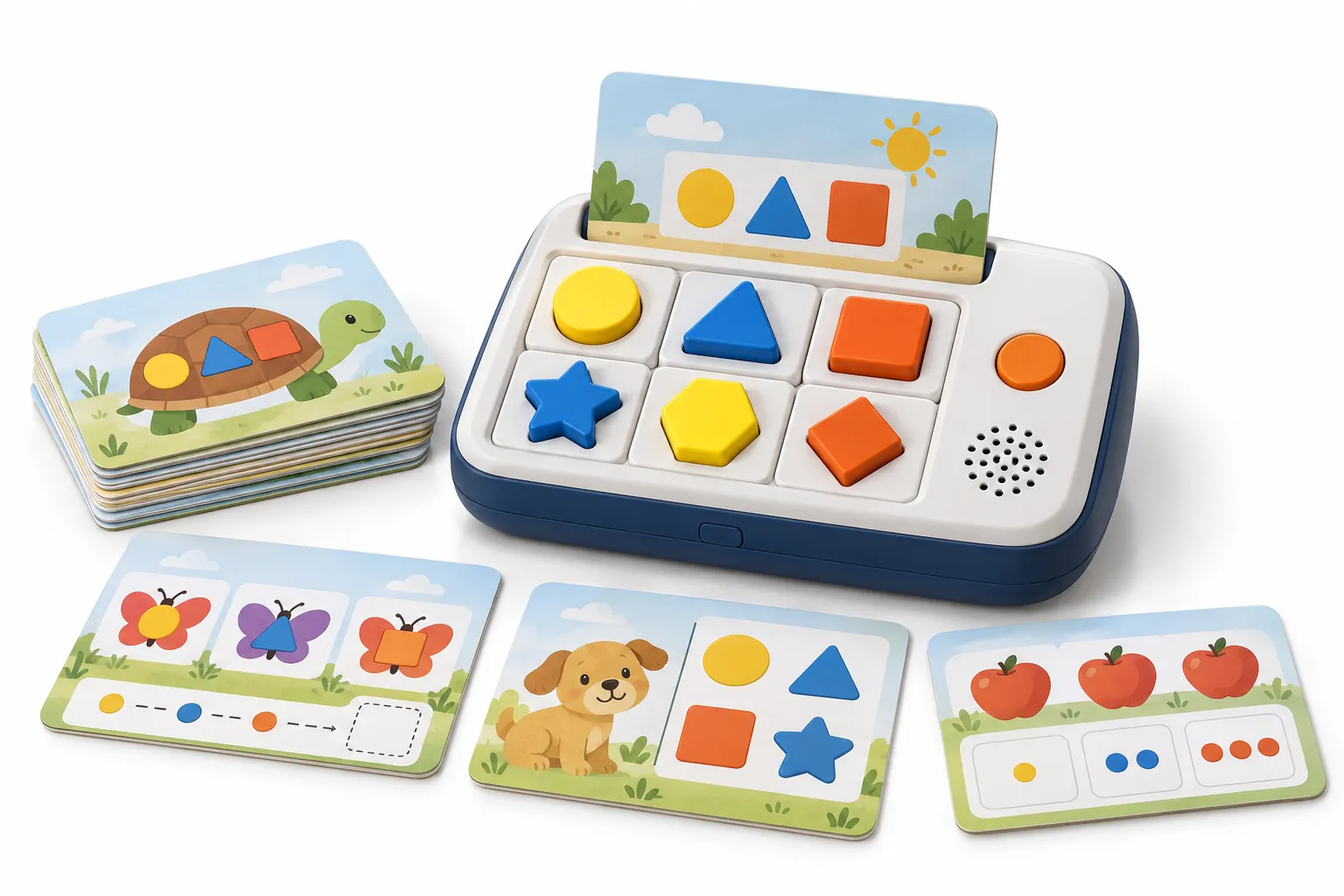
New logic-learning cards look like printed content, but every answer position must remain mechanically and electronically compatible with the installed machine base. For an overseas buyer, the visible feature is only the beginning. The released product must connect customer requirements with activity artwork, physical board geometry, answer-detection pattern, firmware logic, machine fixture, and expansion packaging, approved samples, production instructions, factory testing and the final shipment configuration.
This guide is written for education brands and publishers building multi-level logic learning systems. It explains logic learning machine content update as a product-development and sourcing decision, including the technical interfaces, evidence, quotation assumptions and production controls that should be closed before mass materials are committed.
There is no universal setting that fits every model. Intended age, content, power architecture, destination market and sales channel can change the answer. The practical method is to define observable requirements, test the production-intent configuration and retain records that identify exactly what was approved.
How can a logic learning machine support new content?
Support new content by maintaining a controlled board geometry and answer-map registry, reserving IDs or detection patterns, documenting firmware and machine versions, and testing new boards on representative retained machines. Label expansion editions clearly and release artwork, answer keys, audio if any and package information as one compatible set.
First define whether compatibility means new packs work with all previous machines or only a named generation. That commercial promise determines testing and inventory communication. Start with the intended user action and the business promise. Then convert broad language such as “clear,” “durable,” “fast” or “compatible” into a starting condition, action, expected result and evidence method. This gives the buyer and factory one basis for sample approval.
The risk review should specifically consider answer key mapped incorrectly, board location shifted during artwork, material thickness changes detection, and new board unsupported by old firmware. These failure modes do not all require the same control. Some should be prevented through design, some screened during factory testing, and others verified through a controlled shipment inspection sample.
1. Define the expansion-content roadmap before requesting a quotation
List age levels, learning objectives, activity types, answer positions, languages, feedback modes, planned packs, machine versions, package format and standalone versus bundle sales. Record mandatory, preferred and optional requirements separately. If a point is still unknown, label it as an open decision with an owner and due date instead of allowing the supplier to convert it silently into a production assumption.
Reference products can clarify size, interaction or finish, but they do not disclose internal components, rights, safety assessment or manufacturing history. The written brief should explain what to retain, what to change and what the buyer expects to prove on the sample.
A useful quotation baseline also identifies target quantity, destination market, package contents, language or SKU count, required delivery date and who supplies each content or artwork file. These facts affect engineering work, test scope, tooling, material purchasing and lead time.
2. Review the complete logic-content compatibility system, not one isolated component
A print change can shift an answer marker, while a material or thickness change can alter seating and sensor response. Content and mechanics require one release process. Map every interface between activity artwork, physical board geometry, answer-detection pattern, firmware logic, machine fixture, and expansion packaging. A decision that appears local can alter detection, audio, runtime, mechanical strength, compliance evidence or packing accuracy somewhere else in the system.
Ask the supplier to separate proven platform capability, configurable behavior and new engineering. A familiar enclosure or module does not make a new configuration proven when content, components or use conditions have changed.
Maintain an answer-map registry
Assign stable activity and answer identities, record correct responses and protect reserved ranges. Review educational logic separately from machine mapping.
Document the accepted condition for this area and connect it to activity and answer registry. During review, test the difficult case related to answer key mapped incorrectly rather than demonstrating only the easiest normal use.
Control physical compatibility
Keep datum edges, thickness, cutouts, orientation and answer locations inside the validated tolerance window for the installed machine generation.
Document the accepted condition for this area and connect it to controlled die-line and artwork. During review, test the difficult case related to board location shifted during artwork rather than demonstrating only the easiest normal use.
Communicate editions and supported machines
Use understandable model or generation names on packs and listings. Customer service and distributors should have the same compatibility matrix.
Document the accepted condition for this area and connect it to compatibility matrix. During review, test the difficult case related to material thickness changes detection rather than demonstrating only the easiest normal use.
3. Use staged samples to close the highest-risk questions
Prototype representative activity types and difficult answer positions before completing the pack. Use production-intent board material and cut geometry, then cross-test retained old and new machines. Early engineering samples should answer uncertain technical questions even if color, artwork or packaging is temporary. Mark every temporary part and simulated function so the buyer does not mistake a presentation sample for a production approval.
The integrated sample should combine production-intent files, critical components, enclosure and user interaction. Review it with a dated checklist, record failures precisely and issue corrections through a controlled change list. The next sample should state which changes were incorporated and which tests were repeated.
Freeze a golden sample only after the buildable configuration is understood. Record model, SKU, language, firmware or content identity where applicable, visible artwork revision, accessories and package version. A photograph alone cannot identify every approved internal detail.
| Decision area | Approval question | Evidence to retain |
|---|---|---|
| Maintain an answer-map registry | Expansion roadmap and supported machine generations | activity and answer registry |
| Control physical compatibility | Controlled board dimensions and datums | controlled die-line and artwork |
| Communicate editions and supported machines | Activity and answer-map registry | compatibility matrix |
4. Build factory testing around realistic product use
Verify every correct answer and representative incorrect choices, orientation handling, feedback timing and repeated use. Cross-test both directions when backward compatibility is promised. The core validation should cover Board dimensions and orientation check, Every correct-answer mapping verification, Representative incorrect-answer behavior, and Legacy and current machine cross-test. State the unit condition, power state, test media, action, number of repetitions and acceptance outcome so another person can reproduce the check.
Separate design verification, line screening and shipment inspection. Development testing explores the design and known limits. Line testing detects assembly, programming or material errors quickly. Shipment inspection samples the released lot and confirms pack-out. One stage cannot replace the other two.
When a unit fails, record the symptom, configuration, test step and production time. Contain affected material, investigate the mechanism and update the source process. Repairing the individual sample without showing why it failed does not demonstrate production control.
- Board dimensions and orientation check
- Every correct-answer mapping verification
- Representative incorrect-answer behavior
- Legacy and current machine cross-test
- Language and feedback-mode review
- Edition and pack-count confirmation
5. Carry the approved decision into mass production
Release answer map, artwork and package together. Printing inspection should control datums and answer locations before cutting; final assembly should sample across print sheets and activity ranges. Incoming inspection, first-off approval and in-process checks should focus on the characteristics that can change the promised user result. For this project, the control plan should make board material and thickness check, print and cut registration inspection, answer-map file verification, and machine functional sampling visible to line and quality teams.
Use controlled work instructions and fixtures. Record fixture identity, software or reference-media version and pass criteria where they affect the result. A fixture that is not verified can approve the same defect across an entire lot.
At shipment inspection, select cartons from different production periods and pallet positions. Verify product identity, representative critical functions, appearance, accessories, labels and retail packing together. A correctly functioning product packed under the wrong language or SKU is still a release failure.
- board material and thickness check
- print and cut registration inspection
- answer-map file verification
- machine functional sampling
- edition identification control
- complete expansion-pack counting
6. Compare quotations and schedules on the same scope
Budget educational design, translation, artwork, prototype boards, answer programming, printing and compatibility testing. Expansion packs may share machine development while carrying their own print minimums. Request written assumptions for engineering, tooling, content or prepress work, sample rounds, test fixtures, laboratory work, packaging and production. Compare complete configurations and the same Incoterm rather than using unit price as the only decision.
Approval time belongs on the critical path. Show buyer review days, factory working days, correction loops, component purchasing, printing, laboratory lead time and shipment booking separately. A short quoted lead time is not useful if it begins only after multiple undefined approvals.
The most economical option is the one that reaches a stable, saleable configuration with controlled repeat orders. Rework, relabeling, wrong-language stock or an unplanned redesign can cost more than the difference between two initial quotations.
| Commercial factor | What to confirm | Hidden-cost risk |
|---|---|---|
| Content | Activities, levels and languages | Revision workload |
| Compatibility | Machine generations and firmware | Unsupported customers |
| Printed packs | Board count and SKU mix | Inventory complexity |
7. Preserve traceability for shipment, feedback and reorders
Archive every board edition, answer map, machine version and compatibility result. Do not reuse retired identities while packs may remain in homes or distributor inventory. The release package should make activity and answer registry, controlled die-line and artwork, compatibility matrix, and firmware version record traceable to the finished lot. Store it with the approved sample and identify the effective production date or lot so warehouse stock and later complaints can be compared with the correct configuration.
For a repeat order, compare the current bill of materials, suppliers, files, artwork, labels, test methods and destination-market assumptions with the archived release. Any substitution should explain the reason, affected characteristics and required revalidation before production.
Field feedback should include model, lot, market, use conditions and symptom. Compare the report with retained samples and test records, then separate isolated damage from a repeatable pattern. Credible corrective action keeps the conclusion proportionate to the evidence.
Buyer release record
Create a one-page release index that links every required record to its controlled location. Purchasing, engineering, quality and the shipment inspector should be able to identify the same approved configuration without reconstructing decisions from email.
List open deviations separately. State what differs, why it is accepted, who approved it and whether the deviation applies to one lot or becomes a permanent specification change.
Factory handoff and shipment inspection
Translate customer requirements into line instructions and a concise inspection plan. Include the reference sample, test sequence, sample selection, critical defects, package checks and escalation route for an uncertain result.
The inspector should not invent acceptance rules at the warehouse. Questions must return to the approved specification, and any concession needs written buyer authorization before shipment release.
Change triggers after launch
Treat a component supplier change, edited content, new language, revised claim, packaging change, manufacturing-site change or destination-market change as a review trigger. Not every change requires every test, but the impact assessment should be documented.
This lifecycle discipline is especially important for children’s electronic products because visible appearance may remain identical while firmware, audio, print coding, cell, speaker or internal material changes.
8. Prepare an evidence-based supplier review
Ask for a compatibility matrix and retained-machine cross-test before announcing that a new pack works with an existing installed base. Build a review sheet with four columns: requirement, current decision, evidence needed and responsible owner. Use it during quotation, sample review, pilot production and final release so unresolved issues remain visible.
Ask suppliers to explain assumptions and limitations. A strong technical answer identifies dependencies and proposes a way to verify them; it does not promise universal performance from a catalogue image or a component data sheet.
Before the purchase order, reconcile the quotation, review sheet, approved sample, package list and compliance responsibility matrix. The result should describe one buildable configuration rather than a collection of separately approved parts that were never evaluated together.
Frequently asked questions
Can new activity cards work with an old machine?
Only when physical geometry, answer mapping and firmware behavior support that combination and testing confirms it.
Should answer IDs be reused?
Avoid casual reuse because older packs may remain in the market. Maintain a controlled registry.
Can expansion cards use different board material?
Only after seating, durability and answer detection are revalidated across supported machines.
How should difficulty levels be organized?
Use defined learning objectives, activity types and progression, then keep machine mapping separate from editorial approval.
What belongs on the expansion package?
Show supported machine generation, language, activity level, board count and any required update or accessory.
What should production inspection verify?
Verify dimensions, print/cut registration, answer mapping, functional detection, language, edition and complete pack-out.
Conclusion
Logic learning expansion works when educational content, answer maps and physical compatibility share one controlled release. A clear generation promise and two-direction testing protect the installed base.
A reliable logic learning machine content update decision connects customer requirements with measurable approval criteria, controlled production evidence and a traceable shipment configuration. Share the intended user, content, target market, quantity and timing to begin a focused OEM review.
Authoritative references
Requirements change and differ by product. Use the current official source and qualified professional advice for the final project.