
How to Customize an Interactive Talking Toy: Character, Audio and OEM Production
A buyer’s guide to developing a character-shaped talking toy or point-and-play figurine with controlled audio content, child-appropriate construction and reliable production testing.
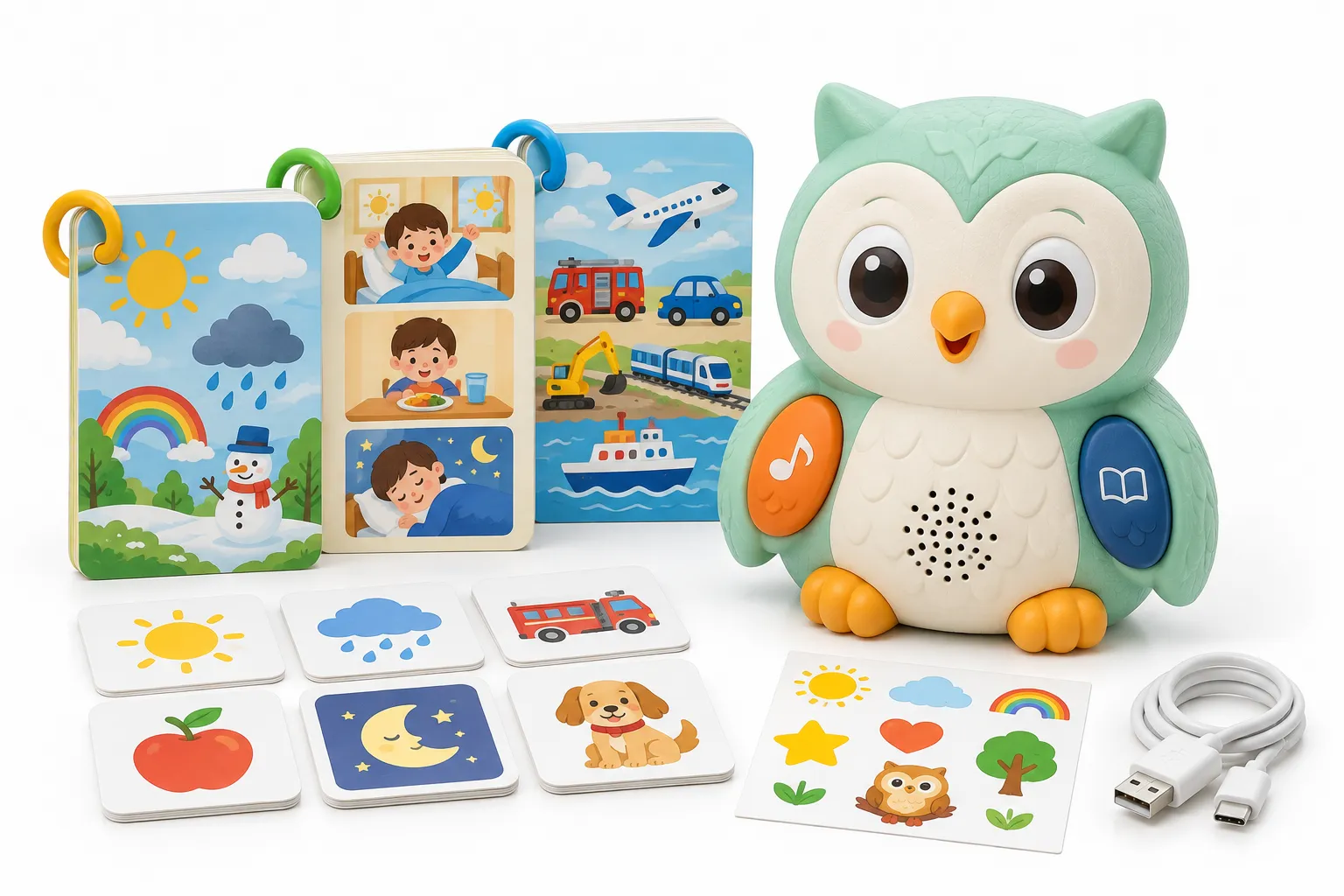
An interactive talking toy can turn a mascot, story character or educational concept into a physical product. The child may press a hand, tap a card, select a mode or place the character on printed content to hear words, songs or guided activities. From a buyer's perspective, however, the project is not simply a figure with a speaker. It is a coordinated system of character design, user controls, audio rights, electronics, firmware, materials, packaging and market compliance.
The first development decision is what the toy should do consistently. A compact point-and-play figurine with external learning cards has a different architecture from a push-button storytelling character. A soft plush body creates different speaker, battery and cleaning considerations from a molded plastic housing. Defining the product route early allows suppliers to quote comparable scopes and identify genuine technical risk.
This guide explains the information an interactive talking toy manufacturer needs, the evidence a buyer should request and the checkpoints that connect an attractive sample to stable mass production. It does not promise a universal cost, schedule or certificate because those depend on the final construction, functions and destination market.
How is a custom interactive talking toy developed?
A custom interactive talking toy is developed by defining the play behavior, converting approved character artwork into manufacturable construction, selecting activation and audio electronics, preparing controlled voice files, validating samples and testing the final configuration for function, durability and applicable toy requirements.
A capable project team separates the creative identity from the technical platform, then makes them work together. Character proportions, colors and facial details may be brand-critical. The speaker location, battery compartment, buttons, sensors and assembly joints must still fit inside that design without creating confusing controls or fragile features.
The fastest route is often an existing electronics platform inside a modified or custom exterior. That does not make the project trivial: the new enclosure can change sound, button force, stability, accessible parts and compliance coverage. A full custom PCB and firmware may be justified for distinctive interaction, but it adds engineering, testing and component-management work.
Before requesting a 3D model, write the first 60 seconds of play: how the child starts, which action triggers content, what is heard, how content changes and how the product stops or sleeps.
1. Select the product route that fits the customer requirements
Begin with the intended product application and sales channel. A publisher may want a character that activates companion cards or books. A gift brand may prioritize songs, phrases and a simple press-to-play button. An educational distributor may need language modes, volume control and organized content packs. Each scenario changes the number of controls, identifiers, audio assets and accessories.
Choose between a molded character, a plush toy with an internal module, or a hybrid design. Molded housings support defined surfaces, stable buttons and wipeable exteriors. Plush can create a softer emotional character but requires careful module retention, seam construction, speaker transmission and access decisions. Hybrid products can combine a molded interactive base with soft decorative parts, but every material interface must be evaluated.
Then define customization depth. Private-label work may use an existing body with new colors, logo, audio and packaging. A modified platform may add a new head, accessory or control layout. A full custom program may require industrial design, new molds, a custom PCB and new firmware. Use these specific terms in the request for quotation rather than relying on inconsistent labels such as OEM and ODM.
| Development route | Typical customization | Main advantage | Main validation need |
|---|---|---|---|
| Existing platform | Logo, color, audio, cards and package | Lower engineering starting point | Confirm relevance of existing tests and limits |
| Modified platform | New character parts, controls or memory | Stronger differentiation | Review all changed interactions and construction |
| Full custom | New industrial design, tooling, PCB and firmware | Distinctive branded experience | Stage-gate engineering and complete configuration control |
2. Translate two-dimensional character art into a manufacturable product
To convert character artwork into a toy, provide approved views, colors, must-keep features, intended size and pose. The industrial designer then reconciles character identity with wall thickness, parting lines, controls, speaker openings, battery access, stability, assembly and child-accessible features.
Start with the best available source material: front, side and back views; expression references; color values; logo rules; and notes identifying non-negotiable features. If only one illustration exists, expect interpretation. Approve a shape model or digital turntable before detailed engineering so disagreements about the character do not appear after mold construction.
Exaggerated illustration details can be difficult to manufacture. Thin ears, horns, fingers, tails or costume elements may need to be thickened, shortened, softened or integrated into the body. The design must also stand or sit reliably in the intended play position. An OEM team should explain changes and preserve the visual intent rather than silently altering the character.
Color approval needs physical references. Screen colors vary, and plastic, paint, pad printing and fabric reflect light differently. Define which areas use molded color, coating, printing or labels. Keep an approved color sample under controlled lighting for production comparison, while recognizing that material and process tolerances must be agreed rather than described as perfectly identical.
Intellectual-property ownership should be clear before tooling and audio work. The buyer should have appropriate rights to use the character, artwork, names, music and voices supplied to the factory. The manufacturing agreement should address file handling, mold ownership, approved subcontracting and use of the design in portfolios or trade samples.
3. Design interaction and feedback around the character
Activation should feel related to the character and remain easy to find. A hand, belly, badge or base can contain a button. A sensor can recognize a card, surface or accessory. A selector may change language or mode. Avoid hiding essential controls behind decorative features that vary in thickness or require inconsistent pressure.
Map every input to a defined response and state. If a child presses during playback, does the toy stop, repeat, queue the next phrase or ignore the input? Does a long press change volume? What happens after inactivity or a low-battery condition? These details belong in a firmware behavior table and should be reviewed on the functional sample.
Audio personality is part of the product design. Define the voice age and tone, speaking pace, pronunciation, emotional range and relationship to music or sound effects. Short prompts should remain understandable through the final speaker and enclosure. If the toy teaches words, keep terminology and pronunciation consistent across cards, packaging and any companion book.
For a point-and-play product, define the recognition medium and its tolerance. Printed codes, RFID or contact-based accessories have different cost, range and artwork implications. Test the real card or book construction, not only a laboratory tag. The child should not need an unnaturally precise angle or repeated attempts to trigger content.
- Primary start and stop behavior
- Short press, long press and repeated press rules
- Volume and language selection
- Correct, incorrect and retry feedback if activities are included
- Idle, sleep, wake and shutdown behavior
- Low-power indication and content recovery after interruption
4. Engineer the electronics and child-accessible construction together
The electronics layout influences the entire body. Speaker diameter and acoustic cavity affect sound. Batteries require space, retention and access. Buttons require travel and alignment. Sensors need a reliable detection area. The PCB must be secured so normal impacts do not change control alignment or create loose internal parts.
Power architecture should be based on real use. Replaceable batteries can simplify charging for some channels but require a properly secured compartment and clear replacement instructions. Rechargeable products add a cell, protection circuit, charge connector, cable and status behavior. Runtime should be stated only with a test condition that defines playback, volume, light use and idle time.
Sound output deserves both usability and safety review. The CPSC's toy-safety business guidance directs manufacturers and importers of sound-producing toys to review applicable ASTM F963 sound and volume requirements. Do not copy one competitor's advertised decibel number; the applicable measurement setup and limits depend on product type and how the toy is intended to be used.
The final materials and construction should be reviewed for the intended age and destination market. IEC 62115 addresses electrical safety aspects of electric toys, while chemical, mechanical, flammability, labeling and other obligations arise from relevant regional rules. Use a qualified laboratory to identify the correct scope for the final configuration rather than assuming that an existing report automatically covers a changed character.
| System | Key decision | Useful sample evidence |
|---|---|---|
| Speaker | Location, clarity, volume range | Final-like enclosure with representative speech and music |
| Controls | Position, force, accidental activation | Repeated use across intended body material |
| Power | Replaceable or rechargeable, runtime behavior | Defined cycle test and low-power behavior |
| Structure | Joints, fasteners, accessible openings | Tooling sample in intended materials |
| Recognition | Range, orientation and valid accessories | Representative production-process cards or objects |
5. Control voice recording, audio processing and installation
Create a content script with unique IDs before recording. Include the final line, context, voice direction, pronunciation notes, expected duration, language, trigger and status. This lets the voice provider record the intended meaning and gives engineers stable references for file mapping. Separate draft, approved master and device-ready files.
Audio processing should be evaluated on the product, not only through headphones. Compression, normalization and equalization may help speech remain clear on a small speaker, but excessive processing can make a voice harsh. Music and effects should not overpower instructions. Approve representative long and short files before processing the entire library.
Translations need contextual review. A line that fits an English playback window may become longer in another language. Character catchphrases, rhymes and educational terms may require adaptation rather than literal translation. Use reviewers who understand the target audience, and keep a terminology record that connects approved text with its recording.
Installation preparation should lock the firmware version, audio package, language combination, memory image and SKU before mass programming. The factory should use a controlled master and record the current build. If content can be updated later, define who can create packages, how versions are identified and how a failed update is recovered.
6. Use staged sampling to reduce tooling and content risk
An appearance model can confirm the character, size and pose before tooling. A separate electronics prototype can demonstrate activation, audio and firmware. Combining those streams too early can make cosmetic decisions depend on temporary hardware or hide interaction problems behind an attractive model.
After digital and appearance approval, detailed engineering defines parts, joints, screws, speaker openings, button mechanisms, battery access and internal supports. Tooling samples should be reviewed for fit, surface, color, decoration and function. Any hand finishing or temporary part on a sample should be recorded so it is not mistaken for a mass-production process.
A content sample should carry a representative audio library, including the longest file, shortest prompt, music, every language and every interaction type. Test companion cards or books made with a representative print process. The pilot build then checks whether operators can assemble, program, test and pack the product consistently using released instructions.
Keep an approved golden sample and a configuration sheet. They should identify the device revision, materials, colors, firmware, audio package, accessories, labels and packaging. When changes occur, issue a written change request describing cost, schedule, inventory and validation effects before implementation.
7. Make factory testing and shipment inspection product-specific
Production testing for an interactive talking toy should verify every control and sensor type, the correct firmware and audio package, speaker clarity, volume behavior, power functions, assembly and required accessories. Shipment inspection should compare packed production with the approved sample, artwork and market labels.
Incoming inspection should confirm critical electronics, approved materials, printed components and batteries against released specifications. First-article inspection should check internal routing, speaker position, fasteners, button alignment, firmware and appearance before the line produces a larger quantity. In-process controls should prevent rework from damaging wires, seams, paint or printed surfaces.
Functional stations need controlled test inputs. For button toys, exercise all button locations and defined press types. For recognition products, test representative codes, cards or accessories across the detection area. Confirm speech, music, lights, language switching, volume, sleep, charging or battery behavior and recovery from interrupted playback.
Factory testing should also verify the installed content identity. A unit can pass an audio-output test while carrying the wrong language or an old script. Use a version display, diagnostic code, file checksum or another defined method appropriate to the platform, then record the result in the production control plan.
During shipment inspection, samples should be selected from finished cartons. Check quantity, workmanship, character colors and decoration, functions, audio, accessories, instructions, labels, retail package and shipper condition under the agreed plan. If a defect requires rework, isolate the lot, correct the cause and re-inspect the affected characteristics rather than replacing only the sampled unit.
8. Compare interactive talking toy manufacturers with evidence
Ask potential suppliers to review one character and one interaction sequence. A useful response should identify design constraints, electronics options, file requirements, sample stages and likely compliance questions. A generic catalogue and a rapid price are not enough to demonstrate capability for a custom program.
Request a quotation that separates design, prototypes, molds, electronics, firmware, audio processing, accessories, packaging, testing and recurring unit cost. Confirm mold ownership, maintenance and storage; rights to firmware changes; treatment of character files; and the process for future languages or content packs.
Review the factory's document discipline. Look for controlled bills of materials, drawings, approved samples, programming masters, work instructions, functional fixtures, defect records and shipment-release criteria. A clean workshop photograph does not show whether the correct content version reaches the correct SKU.
Finally, evaluate communication. Character products involve creative and engineering feedback, so each decision should have an owner and revision. The supplier should flag conflicts instead of guessing, especially when customer requirements affect appearance, safety, tooling or licensed content.
Frequently asked questions
What files are needed to make a custom talking character toy?
Provide character views, color references, logos, dimensions or size targets, intended pose, function list, audio script, language plan, age grade, quantity, market and packaging requirements. Editable artwork and proof of relevant IP rights are helpful before engineering starts.
Can I use my own voice or licensed character audio?
Usually yes if you hold the necessary rights and provide suitable files. Document voice, music and character permissions, then test device-ready files through the actual speaker and enclosure before approving the library.
Is a plush or plastic talking toy better?
Neither is universally better. Plastic supports precise controls and defined surfaces; plush offers a soft character experience but adds module, seam and acoustic considerations. Choose according to the intended play pattern, age, cleaning expectations and brand design.
How much does a custom talking toy mold cost?
Cost depends on size, part count, geometry, material, surface, decoration, mold construction and expected production volume. A manufacturer needs approved or sufficiently developed 3D data to provide a meaningful tooling quotation.
How should talking toys be tested before shipment?
Verify every activation method, representative content, correct language and version, speaker quality, volume, indicators, power, assembly, appearance, accessories, labels and packaging against the approved specification and sample.
Which safety standards apply to a talking toy?
The scope depends on intended age, construction, power source, sound, accessories and destination market. The responsible business should review applicable toy, chemical, mechanical, sound, electrical and labeling requirements with a qualified laboratory for the final model.
Conclusion
A professional interactive talking toy program protects the character while engineering a product that children can understand and factories can reproduce. Visual design, audio personality, controls, electronics and compliance are interdependent decisions.
Define the first play sequence, approve the character and content through staged samples, and make factory tests reflect the actual interaction. That creates a stronger basis for quotation, licensing review, production control and future content expansion.
Authoritative references
Requirements change and differ by product. Use the current official source and qualified professional advice for the final project.