
How to Manufacture a Custom Sound Book: Audio, Print and Quality Guide
A practical OEM guide for publishers and educational brands coordinating book design, button mapping, audio electronics, print production, assembly and export quality control.
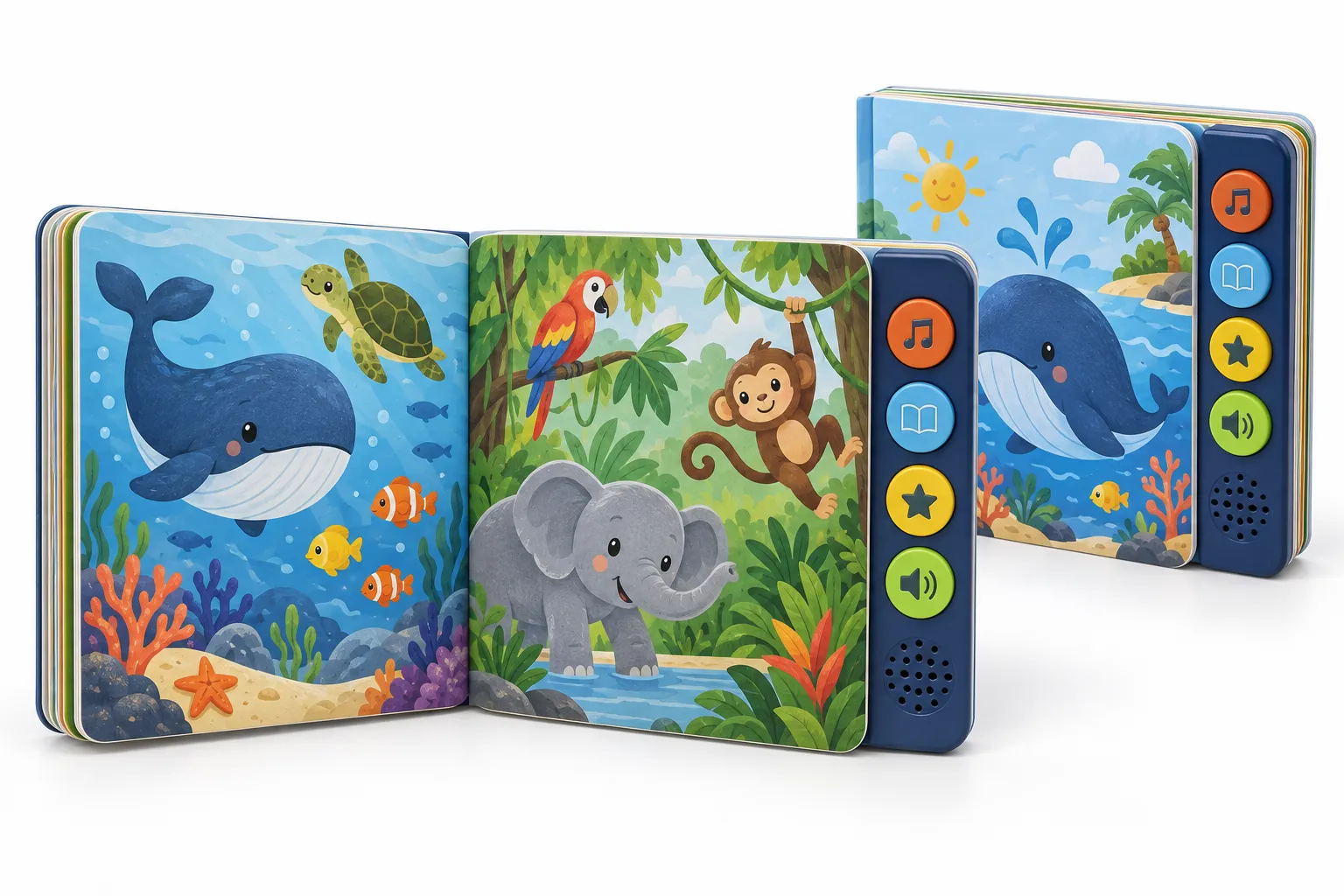
A custom sound book combines two production disciplines that are often managed separately: printed book manufacturing and electronic audio assembly. The page artwork must align with a button panel or touch area; each icon must trigger the correct file; the module must fit the board structure; and the finished product must remain usable after repeated pressing and normal child handling.
This integration is why an attractive digital layout is not yet a manufacturable sound book. A publisher needs a controlled dieline, bleed and safe areas, button coordinates, audio IDs, module dimensions, battery and speaker details, page construction, assembly tolerances and a defined test method. Decisions made after printing or tooling can be expensive to correct.
The following guide helps toy brands, publishers, retailers and education companies prepare customer requirements, compare a custom sound book manufacturer and control the project from initial specification through shipment inspection. It uses practical checkpoints rather than unsupported claims about minimum order, battery life or universal certification.
How is a custom sound book made?
A custom sound book is made by defining the page and button format, engineering an audio module, mapping every trigger to an approved file, preparing print-ready artwork, validating proofs and electronic samples, assembling printed board with the module, and testing function, construction, labeling and packaging before shipment.
The book can use a side panel with visible buttons, buttons integrated into pages, a sound module attached to the back cover, or a more advanced touch-sensing system. The side-panel board book is common because controls remain available while pages turn, but the best format depends on page count, content, intended age, retail size and desired interaction.
A sound book manufacturer should be able to connect print and electronics documentation. If one factory supplies the module and another prints the book, one party still needs responsibility for the final interface: dimensions, button position, lamination, adhesive, wire routing, module insertion and finished-product testing.
Freeze the book architecture and button count before final artwork. A change in module or panel size can alter every spread, the cover, the dieline, the package and the shipping weight.
1. Choose a sound-book format that matches the content
Begin with the content behavior. A ten-button animal book may assign one sound to each visible icon and reuse the same panel across pages. A storybook may use page-specific buttons or a selector that changes the active page. A nursery-rhyme book may need longer files, stop and replay behavior, while a vocabulary book may use shorter pronunciations with more individual triggers.
Board books suit younger users because the pages are thick and easy to turn, but board thickness, lamination, corner shape and binding must be defined. A paper-page sound book can support more pages and lighter weight but may require a different age position and durability expectation. A plastic sound panel can be exposed, wrapped with printed material or integrated into a thick back cover.
The number of buttons affects electronics, layout, cost and usability. More is not always better. Buttons should be sufficiently separated, visually mapped and easy to press without triggering a neighbor. If content requires many sounds, consider page-selection logic, modes or a different recognition technology rather than crowding the panel.
Product application and retail context also matter. A bedtime title may need a gentle content sequence and straightforward volume behavior. A language product may require bilingual mode selection. A travel title may prioritize compact size and a protected power switch. Write these requirements before asking suppliers to recommend a module.
| Format | Best suited to | Main manufacturing question |
|---|---|---|
| Side-panel button book | Visible reusable sound categories | Can every button remain accessible on all pages? |
| Page-specific buttons | Direct picture-to-sound interaction | How are page layers, contacts and alignment controlled? |
| Back-cover module | Story, music or simple sequence playback | How is the module secured without distorting the cover? |
| Coded touch book | Larger interactive content libraries | How are printed identifiers and sensor response validated? |
2. Prepare a complete sound-book manufacturing specification
A useful sound-book specification defines trim size, page and spread count, board or paper construction, binding, surface finish, corner shape, audio controls, button count and coordinates, module and battery type, audio duration, artwork language, packaging, order quantity and destination market.
Publishers often describe page count differently, so state both printed pages and physical leaves or spreads. Confirm whether the cover is self-ended or separate, whether the button panel is included in the trim size, and which side binds. The supplier's dieline should show cuts, folds, binding margins, panel areas, bleed and safe zones.
Define visible quality expectations without asking for impossible perfection. Agree how color will be referenced, which surface finish is used, acceptable board and lamination condition, corner shape, spine behavior and alignment at the sound panel. If a specific material certification or responsible-paper claim is required, include it before quotation and verify the document route rather than adding a logo at final artwork stage.
The electronic specification should cover activation, on/off behavior, volume, replay, file mapping, total audio duration, speaker, battery, replacement or charging access, inactivity and low-power behavior. Avoid specifying only memory size because compression format and audio quality determine how much useful content it holds.
Commercial requirements belong in the same brief: order quantity, target unit presentation, barcode, price labels, warning and operator information, manual languages, master-carton limits, shipping method and delivery window. These inputs affect package design, testing and quotation.
3. Engineer the audio module around the finished book
The module typically combines a PCB, memory or audio IC, speaker, batteries, controls and wiring inside a support structure or plastic housing. Its footprint and thickness must be reconciled with the book board and cover. A module that sits too high can create an uneven product; an unsupported cavity can deform; poorly routed wires can be pinched during assembly.
Button feel depends on the switch technology, cover layers and alignment. Test force and response through the intended printed overlay, not on a bare module. Icons should sit directly over their active zones. Repeated pressing should not shift the overlay or create visible delamination around the panel.
Speaker performance changes after installation. Openings, board layers, plastic cavities and adhesive can alter clarity and volume. Review speech, music and sound effects on a fully assembled sample at each volume setting. The CPSC advises manufacturers and importers of sound-producing toys to review applicable ASTM F963 sound requirements and measurement provisions; use the final product type and intended use when establishing a laboratory plan.
Power decisions affect structure and labeling. Replaceable cells require a secured battery compartment and instructions appropriate to the intended market and age. A sealed or non-replaceable power design needs a realistic product-life position. Rechargeable designs add charge electronics, a connector and cable considerations. Relevant electrical-toy requirements, including regional use of IEC 62115, should be reviewed for the actual configuration.
| Module element | Decision to document | Sample check |
|---|---|---|
| Buttons | Count, coordinates, force and labels | Every overlay icon triggers only its assigned file |
| Audio | Format, duration, order and volume behavior | Speech and music are clear in the finished book |
| Speaker | Size, cavity and opening | No buzz, blockage or excessive variation |
| Power | Cell type, access and low-power behavior | Closure, operation and instructions match specification |
| Housing | Dimensions, retention and assembly interface | Book closes, sits and handles as intended |
4. Prepare print artwork and audio as one controlled content package
Obtain the manufacturer's final dieline before completing layout. Keep critical text, faces and button symbols inside safe zones; extend background artwork through bleed; and avoid placing important details where binding or the module creates visual loss. Use the required color space, image resolution, font handling and PDF export settings supplied by the printer.
Create an audio map that links every visible button or touchpoint to a unique file ID. Include page reference, printed label, spoken script, language, voice direction, duration, playback rule and approval status. The ID should appear in review files and test sheets even if it is not printed in the consumer artwork.
Use only authorized artwork, fonts, music, voices and sound effects. Stock licenses can differ in whether physical products, large quantities or child-directed applications are permitted. Keep evidence with the project file, and define whether the factory may retain or reuse any assets. Licensed character projects may also require licensor approvals at artwork, sculpt or preproduction stages.
Translations should be reviewed in layout and audio context. Text expansion can crowd a page, while spoken duration can exceed the intended experience. Review pronunciation, age-appropriate vocabulary and cultural relevance with qualified language reviewers. Avoid recording the full library before representative scripts and voices are approved.
Installation preparation should freeze the module firmware or playback logic, final audio package, button map and SKU language combination. The production master needs a release identifier. Last-minute file replacement without updating the map and test reference is a common source of correct-looking books with incorrect audio.
5. Approve digital proofs, print proofs and functional samples separately
A PDF proof is useful for text, basic position and file completeness, but it cannot prove physical color, finish, board behavior or button alignment. A printed proof or wet proof provides better evidence for important artwork decisions. A white sample can confirm size and construction before final print. A functional electronic sample demonstrates playback and interaction.
Record the purpose and limits of every sample. A digitally printed mock-up may use different ink and lamination from mass production. A hand-cut cavity may not represent die-cut tolerances. A prototype module may carry temporary batteries or wiring. Approval should list open items so the sample is not treated as complete evidence of production readiness.
The preproduction sample should combine intended print, construction, module, audio, labeling and package as closely as practical. Test every button on every relevant page state, including repeated and rapid presses. Check page turning, book closure, binding, panel alignment, speaker output, switch access, battery compartment, labels and pack-out.
Maintain a signed or digitally approved reference and associated files. If an audio line, page or component changes, document whether a new proof, functional sample, compliance review or carton update is needed. A disciplined change process protects both the buyer and manufacturer from approving different versions in separate email threads.
For a sound book, print approval and audio approval are not two unrelated tasks. The final approval must prove that the correct printed trigger produces the correct sound in the assembled book.
6. Understand the integrated production flow
A typical program moves from released artwork to plate or print preparation, printing, surface finishing, mounting printed sheets to board, die cutting, page assembly and binding. In parallel, electronics are purchased, boards assembled or programmed, speakers and controls connected, and modules function-tested. The exact order varies by design and factory.
Integration is the critical stage. Operators may place the module into a die-cut board structure, route wiring, align the button overlay, secure the housing and close the cover or panel. Jigs can help maintain position. Work instructions should identify adhesive type and amount, cure time, cable routing, button alignment, speaker orientation and checks before closure.
First-article approval at the start of a production run confirms that current print, components, programming and assembly instructions produce the released product. It should happen before a large quantity is completed. If an operator must compensate manually for a dimensional mismatch, stop and correct the underlying process rather than making the workaround the normal method.
Pack-out controls are especially important when titles, languages or button counts look similar. Each SKU should have a distinct bill of materials and visual reference. Barcodes, package artwork, book audio and carton marks must all identify the same version. Mixed-language cartons can pass basic function checks while still creating a serious customer complaint.
7. Build a factory testing and shipment inspection plan
A sound-book quality plan should control print and board construction, module identity, programming, button alignment, audio mapping, sound output, power access, binding, labels and pack-out. Finished-production inspection should test representative units from sealed cartons against the approved book, audio map and packaging specification.
Incoming inspection can verify electronic parts, batteries, speakers, board, printed sheets and other critical materials against approved references. Module-level testing should occur before the electronics are permanently integrated because faults are easier to diagnose and repair at that stage. Record the programming master or audio version used.
In-process print controls should cover color references, registration, coating or lamination, die cutting and board mounting. Assembly controls should verify page order, binding, module position, button alignment, wiring and adhesive. A book can have perfect audio yet fail commercially because pages are reversed, the panel lifts or the cover does not close flat.
Functional testing should include every button on every selected unit where practical, since a missed or cross-mapped button is a direct user failure. Also test on/off, volume, replay or mode controls, speaker clarity, interrupted presses, inactivity and low power as defined. Use a fixture or test sheet that matches the current button map, not an earlier title.
Shipment inspection should sample finished cartons across the lot and verify quantity, workmanship, complete function, title and language, labels, instructions, battery status if applicable, retail package and shipper condition. Agree defect classifications and acceptance criteria before production. Compliance testing and shipment inspection answer different questions and should not be substituted for one another.
8. Compare custom sound book manufacturers
Evaluate whether the supplier controls both sides of the product or has a documented interface between print and electronics partners. Ask who owns the final dimensions, who approves the module-to-book fit and where finished-product functional testing occurs. A low module price is not useful if integration responsibilities are unclear.
Send the same brief to shortlisted factories and compare like with like. Confirm page construction, module configuration, button count, audio duration, packaging, testing and included development work. Separate one-time costs such as dielines, tooling or audio preparation from repeat unit costs. Ask which materials or processes drive minimum order quantity.
Review relevant samples, but do not assume they prove capability for your title. Give the factory a small test package containing a dieline page, three to five audio files and a button map. Its questions, file control and functional sample can reveal more than a showroom of unrelated books.
Request documents tied to the actual configuration: material specifications, component details, applicable test reports or plans, quality procedures and shipment records. The final compliance responsibility varies by market and commercial role, so state who is the manufacturer, brand owner and importer rather than assuming the factory handles every legal obligation.
| Supplier question | Strong evidence | Warning sign |
|---|---|---|
| How are print and module aligned? | Released dieline, coordinates and assembly jig | Alignment described only as manual experience |
| How is audio controlled? | Versioned map, master package and test sheet | Files exchanged without IDs or status |
| What is tested? | Module and finished-book function records | Only a power-on demonstration |
| What does the quote include? | Defined construction, electronics, packing and testing | A unit price without a technical scope |
| Are reports applicable? | Model and construction reviewed against documents | Generic certificates presented as universal coverage |
Frequently asked questions
What information is needed for a custom sound book quote?
Provide trim size, page and spread count, board or paper preference, button count, audio list and duration, languages, intended age, quantity, destination market, packaging and artwork status. A reference layout or manuscript helps clarify the interaction.
How many sound buttons can a children's book have?
The practical number depends on panel size, button spacing, module design and content logic. More buttons increase layout and electronics complexity. Ask the manufacturer to demonstrate the proposed spacing and activation on a physical sample.
Can I provide my own voice recordings?
Yes, if you have the necessary rights and the files meet agreed technical requirements. The factory should process or convert approved masters as needed and test the device-ready versions through the finished book.
Should artwork be finished before contacting the manufacturer?
A manuscript and rough layout are enough for early feasibility, but final artwork should use the manufacturer's approved dieline. Do not complete every spread on an assumed panel size that may change after module selection.
How are sound books tested in production?
Factories should test modules before integration and finished books after assembly. Checks typically cover every trigger, audio mapping, speaker, controls, power behavior, page order, binding, alignment, labels, packaging and SKU identity.
Which safety requirements apply to a children's sound book?
The answer depends on whether the finished product is classified as a toy, the intended age, materials, electronics, batteries, sound output and destination market. Obtain a product-specific review from the responsible party and qualified laboratory.
Conclusion
A sound book is reliable when the printed object and electronic module are treated as one controlled product. Page design, button mapping, audio processing, module engineering, assembly and testing all depend on the same released specification.
Publishers can reduce avoidable risk by freezing the architecture before final layout, approving physical and functional samples separately, and making shipment inspection follow the exact audio map and SKU. That process turns a creative manuscript into a repeatable export product.
Authoritative references
Requirements change and differ by product. Use the current official source and qualified professional advice for the final project.