
Electronic Learning Toy Compliance and Quality Control: A Buyer’s Guide for the US and EU
How importers and education brands can connect age grading, product configuration, laboratory testing, factory controls and shipment inspection.
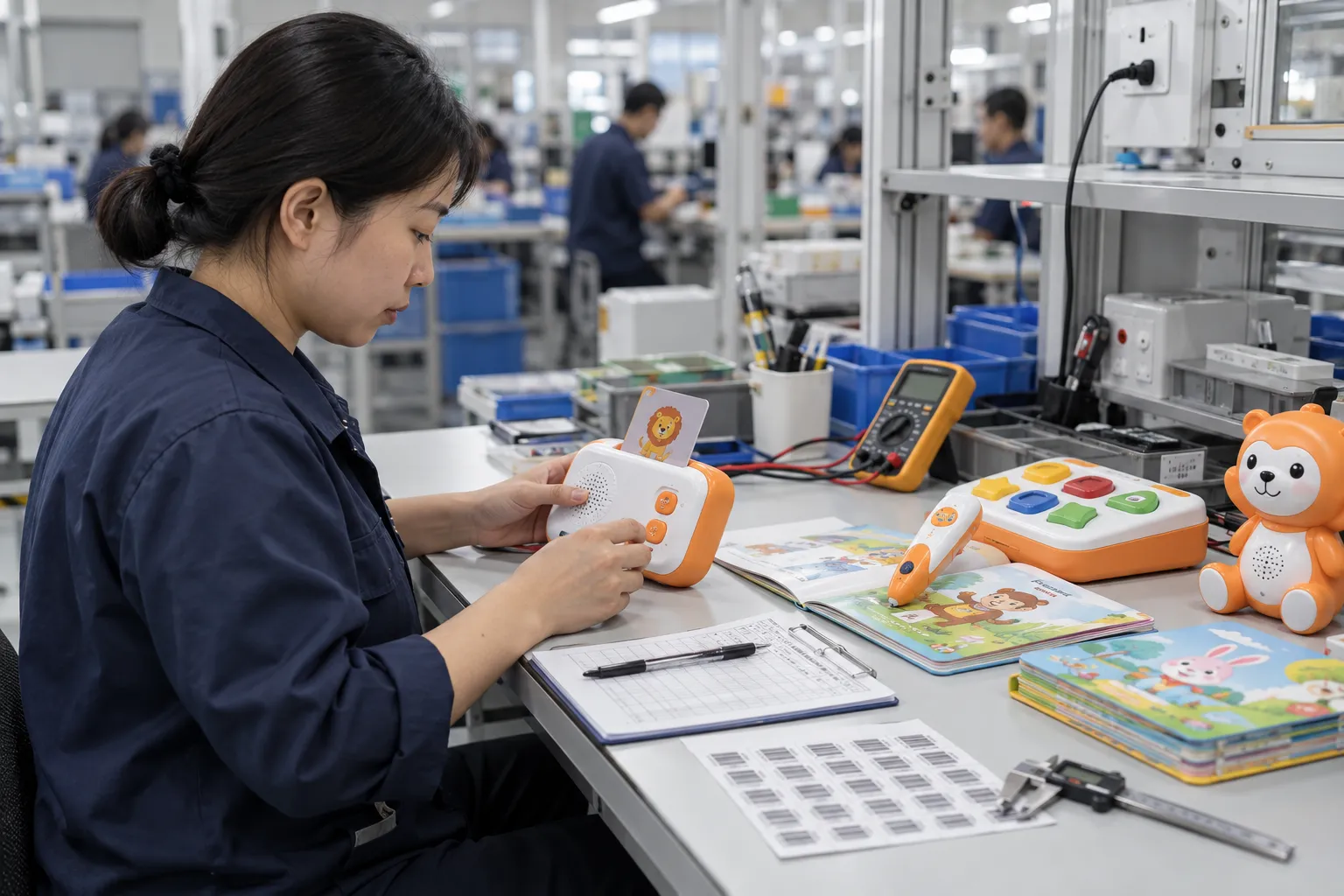
Electronic learning toys combine several risk areas: child use, plastics and coatings, small components, sound output, batteries or charging circuits, printed accessories and software-controlled functions. A laboratory report is important, but it is only one part of a reliable order. The tested construction must be translated into purchasing, assembly, factory testing and shipment release controls.
The buyer, manufacturer, importer, laboratory and retailer may each hold different responsibilities. Those responsibilities vary by destination market and product configuration. This article does not provide legal advice or replace a qualified compliance assessment. It explains how an OEM buyer can organize the project so that regulatory review and production quality support each other.
The central principle is simple: define the actual product, test the correct representative sample, freeze the approved configuration, control production changes and inspect the shipment against the same reference.
What does electronic learning toy compliance require?
Electronic learning toy compliance requires the responsible business to identify applicable rules for the product, age grade and market; test representative samples where required; maintain the correct certificates and technical records; and keep mass production consistent with the assessed construction. Generic supplier certificates do not replace a configuration-specific review.
Compliance and quality control answer different questions. Compliance asks whether the product meets applicable legal and safety requirements. Quality control asks whether production units conform to the approved specification and customer requirements. They overlap because an uncontrolled material, battery, speaker, screw, coating or firmware change can affect both.
Do not build a document checklist before defining the product. A rechargeable talking pen, a battery-operated sound book and a card reader with Bluetooth may follow different evaluation paths. Intended age, accessible parts, electrical functions, sound behavior, materials, packaging and wireless features all matter.
Treat the approved test sample and bill of materials as a controlled construction. If production changes a safety-relevant part, pause and review the effect with the responsible compliance professional before shipment.
1. Define the product, market and responsible parties
Begin with an accurate product description: intended age, play or learning pattern, power source, charging method, electronic functions, accessories, printed content, packaging and warnings. Marketing language should not conflict with the physical product or age assessment. A product presented for very young children may face different small-parts and use-and-abuse considerations from a product clearly intended for older children.
Next, identify the economic operators and decision owners. The factory controls manufacturing. The brand owner controls customer requirements and often artwork. The importer may hold certification and market-surveillance responsibilities. A laboratory interprets standards and performs defined tests, but it does not take over every business obligation. Retailers or marketplaces may add their own document and testing conditions.
Create a responsibility matrix early. It should identify who approves age grading, materials, labels, warnings, manuals, battery information, laboratory scope, certificate content, tracking information and final shipment. This prevents a common late-stage problem in which every party assumes another party owns the missing item.
| Decision | Typical owner | Evidence to retain |
|---|---|---|
| Product definition and age intent | Brand/importer with qualified input | Approved specification and age rationale |
| Manufacturing construction | Factory and buyer | Bill of materials, drawings and approved sample |
| Applicable test scope | Responsible business with laboratory | Laboratory quotation or test plan |
| Artwork and warnings | Brand/importer | Approved packaging, labels and manual |
| Production release | Factory quality and buyer | Inspection records and release approval |
2. Understand the United States compliance route
For US children's toys, the responsible manufacturer or importer must identify applicable CPSC-enforced requirements. ASTM F963-23 is mandatory for toys manufactured after April 20, 2024, with applicable sections certified through a Children's Product Certificate. Required children's-product testing must use a CPSC-accepted third-party laboratory.
The U.S. Consumer Product Safety Commission explains that ASTM F963 covers a wide range of general and toy-specific requirements, so not every section applies to every product. The evaluation may address material quality, hazardous substances, surface coatings, small objects, sound-producing toys and other product-specific hazards. Electrically operated toys may also need review under 16 CFR part 1505 where applicable.
A Children's Product Certificate is not a laboratory certificate. It is issued by the responsible manufacturer or importer and identifies the product, applicable rules, importer or manufacturer, records custodian, manufacturing details and supporting test information. The certificate should be based on the actual product and required passing tests, not copied from a different model.
Tracking information is another important production input. The CPSC notes that children's products require permanent tracking information on the product and packaging, subject to the applicable rules. That means the factory needs approved data and a controlled method for applying it during production.
For a talking pen or sound product, review sound-output requirements carefully. For products with paint or similar surface coatings, confirm lead-in-paint requirements. For small cards, caps, screws or accessories, evaluate age-related small-parts concerns. Wireless functions add another regulatory layer and should not be assumed to be covered by general toy testing.
- Use the current product configuration and intended age to define applicable sections
- Engage a CPSC-accepted laboratory where third-party testing is required
- Prepare the CPC using the responsible party's accurate product and test information
- Control tracking labels and other required markings in the production artwork
- Review electrical, battery, wireless and transport requirements separately as applicable
3. Understand the European Union compliance route and transition
In September 2026, the EU Toy Safety Directive 2009/48/EC remains the main framework for toys placed on the EU market. Regulation (EU) 2025/2509 has entered into force, but most provisions apply from 1 August 2030, when the Directive is repealed. Buyers should plan for the transition without claiming the future regime already applies in full.
Under the current EU framework, the responsible economic operator must address essential safety requirements, conduct the appropriate conformity assessment, prepare technical documentation and the declaration of conformity, apply CE marking and provide required traceability, warnings and instructions. Harmonised standards can provide a presumption of conformity for the requirements they cover when correctly applied.
Electronic learning toys may require assessment across mechanical and physical safety, flammability, chemical properties and electrical safety. IEC 62115 defines international safety requirements for electric toys, and the applicable European adoption may form part of the technical route. The exact standards and editions should be confirmed with the laboratory for the product and placing-on-market date.
Regulation (EU) 2025/2509 introduces a future digital product passport framework and updated chemical restrictions. Its main application date is 1 August 2030, while certain institutional and implementing provisions apply earlier. A brand developing a multi-year product line should monitor implementing acts and prepare data discipline now, but should avoid presenting a future digital passport as a substitute for current documentation.
EU importer and authorized-representative information, warnings, language requirements and online offer information should be reviewed for the intended countries and sales channel. The factory can support technical files and markings, but the EU economic operator must understand its own obligations.
| EU planning point | Current project action | 2030 transition consideration |
|---|---|---|
| Legal framework | Apply the current Toy Safety Directive and other relevant EU law | Prepare for Regulation (EU) 2025/2509 from 1 August 2030 |
| Technical evidence | Maintain safety assessment, test evidence and technical documentation | Plan structured data needed for the digital product passport |
| Traceability | Approve CE, operator details, batch or model information and warnings | Monitor unique identifiers and data-carrier requirements |
| Change control | Keep production aligned with the assessed construction | Retain cleaner digital records for future passport maintenance |
4. Freeze the tested configuration before mass production
A test report describes a sample and a scope. The commercial order must be linked to both. Create a tested-configuration record containing model identification, photographs, dimensions, materials, bill of materials, battery, charger or cable details, circuit or module references, speaker, coatings, accessories, labels, packaging and firmware-related safety behavior where relevant.
The sample sent to the laboratory should be representative of production. Hand-built prototypes can be appropriate for early investigation, but differences must be disclosed. If production tooling, materials or component suppliers are not final, record what remains provisional and determine whether confirmation testing or document review is needed later.
Color changes may appear cosmetic but can involve different pigments or coatings. A new battery may have different protection characteristics and transport documents. A speaker change can alter sound output. A longer screw can become accessible. A firmware change can affect volume limits or charging indications. The change-control process should screen these relationships rather than dividing all changes into “major” or “minor” based on appearance alone.
The safest test report is not the largest PDF. It is the report that can be traced to the construction the factory is actually producing.
5. Build factory controls around the approved product
Once the configuration is approved, translate it into supplier controls, incoming inspection, assembly instructions, functional tests and final inspection criteria. The factory does not need to repeat a full laboratory program on every unit, but it does need practical controls that prevent unapproved materials and detect assembly or functional defects.
Incoming quality control can verify identity, supplier, dimensions, appearance and relevant supporting documents for critical parts. Storage controls matter for batteries, printed materials and sensitive electronic components. First-article inspection should confirm the line is using the current components, artwork, firmware, audio package and work instructions before volume output continues.
In-process controls may include screw torque, soldering or connector checks, battery placement, enclosure fit and controlled software installation. End-of-line factory testing should cover product-specific functions: optical reading, card recognition, button mapping, speaker output, indicators, charging and power states. Printed accessories should be checked for count, revision and visible defects.
Finished-goods inspection should compare appearance and packing with the approved reference. Record defects by type so recurring issues can be investigated. A statement that “100% is tested” is incomplete unless the buyer understands what is tested, with which fixture, against which limits and how failures are handled.
- Approved supplier and component identification for safety-relevant parts
- Current drawings, bill of materials, artwork, firmware and audio versions
- First-article confirmation at line setup and after significant interruption
- Defined functional fixtures or test media with acceptance criteria
- Segregation, repair and re-test records for nonconforming units
- Packing verification against the approved configuration and carton plan
6. Plan shipment inspection before the order is packed
A shipment inspection should verify that finished production matches the approved sample, specification and current artwork. For electronic learning toys, it should cover quantity, workmanship, critical dimensions, functions, audio or content, charging, accessories, labels, packaging and carton condition using an agreed sampling and acceptance plan.
Inspection is most useful when criteria are agreed before production. Define which defects are critical, major or minor; which tests are performed on all selected samples; which destructive or time-consuming checks are handled separately; and what happens if the lot does not meet the agreed criteria.
Inspectors should select samples from finished, packed production across available cartons. Prepared samples from a meeting room do not provide the same evidence. The inspection specification should include photos or clear references for color, printing, labels, product contents and package arrangement.
Functional sampling should represent the product application. For a talking pen, test multiple controlled touchpoints across representative pages and verify the expected audio. For a card machine, test cards across the library rather than one convenient card. For a sound book, verify every button mapping on selected units. Confirm the installed firmware or content version when a reliable method is available.
A passed shipment inspection does not replace compliance testing or factory process control; it is a final check on a sample of the lot. Likewise, a failed inspection should lead to containment, root-cause review, corrective action and re-inspection—not only replacement of the few defective units found.
| Inspection block | Examples | Reference |
|---|---|---|
| Identity and quantity | Model, color, order quantity, carton count | Purchase order and packing list |
| Function | Reading, cards, buttons, audio, charging, indicators | Approved function specification |
| Construction | Assembly, dimensions, accessible parts, workmanship | Approved sample and drawings |
| Content | Correct language, audio mapping, print set and revision | Approved files and content map |
| Marking | Model, batch, operator data, warnings and labels | Approved artwork |
| Packing | Accessories, manuals, retail package and shipper protection | Package specification and carton plan |
7. Control engineering changes and maintain the document pack
Production changes are normal over a product's life. The risk comes from changes made without review. Require the factory to notify the buyer before changing safety-relevant materials, component suppliers, batteries, coatings, dimensions, construction, firmware behavior, manufacturing location or critical process.
Use an engineering-change record that describes the reason, affected models, old and new parts, implementation date, inventory disposition and required approval. The responsible compliance party and laboratory should determine whether existing evidence remains valid or whether additional evaluation is needed.
Maintain a technical and commercial document pack that can be retrieved after shipment. It may include the final specification, bill of materials, drawings, risk or safety assessment, test reports, certificates or declarations, CPC where applicable, artwork, instructions, battery and transport records, approved samples, inspection reports and change history. Retention periods and exact contents depend on the market and applicable law.
This discipline also supports future orders. When a buyer requests a new language or package one year later, the team can identify what changed and what did not. That makes quotation, testing and production preparation more reliable.
8. Use an order-readiness checklist
A purchase order should not be the first place where the product is fully defined. Before the deposit or production release, review the status of the construction, laboratory plan, market artwork, factory quality controls and shipment release criteria.
Open items can remain, but each should have an owner and due date. For example, carton markings may be finalized after a package sample, while material and battery decisions should normally be settled before the representative compliance sample is produced.
Frequently asked questions
Does an electronic learning toy need ASTM F963 testing for the US?
Children's toys sold in the United States must meet applicable mandatory requirements, including applicable ASTM F963 sections incorporated under 16 CFR part 1250. The exact scope depends on the product, intended age and functions and should be confirmed with the responsible party and a CPSC-accepted laboratory.
Is a supplier's existing test report enough for a customized product?
Only if the responsible compliance review confirms that the report covers the actual model, materials, components, age grade and configuration. Changes to housing, coatings, batteries, speakers, accessories or construction may affect coverage.
When will the new EU Toy Safety Regulation apply?
Regulation (EU) 2025/2509 entered into force after publication in December 2025, but most provisions apply from 1 August 2030. The current Toy Safety Directive remains relevant during the transition, while certain regulatory and implementing provisions apply earlier.
What is IEC 62115?
IEC 62115 is an international safety standard for electric toys—products intended for use in play by children under 14 with at least one function dependent on electricity. The applicable national or regional adoption and edition should be confirmed for the destination market.
What should a pre-shipment inspection cover for a talking toy?
It should cover product identity, workmanship, critical functions, audio or content, charging, controls, accessories, labels, manuals, retail packaging and shipping cartons against the approved specification and sample.
Who is responsible for toy compliance: the factory or importer?
Responsibilities depend on the market. The factory must manufacture the agreed construction and provide accurate records, while the manufacturer, brand owner or importer may hold legal certification and market obligations. Define responsibilities explicitly rather than assuming the factory owns every decision.
Conclusion
Compliance and quality control should form one continuous chain. Market requirements define the evaluation; the representative sample and technical file define the approved construction; factory controls keep production aligned; and shipment inspection provides a final lot-level check.
Buyers can reduce risk by refusing generic answers. Ask which requirement applies, which exact configuration was tested, how the line controls that configuration and which record will prove the shipment was checked. Those questions create a more trustworthy basis for working with any electronic learning toy manufacturer.
Authoritative references
Requirements change and differ by product. Use the current official source and qualified professional advice for the final project.